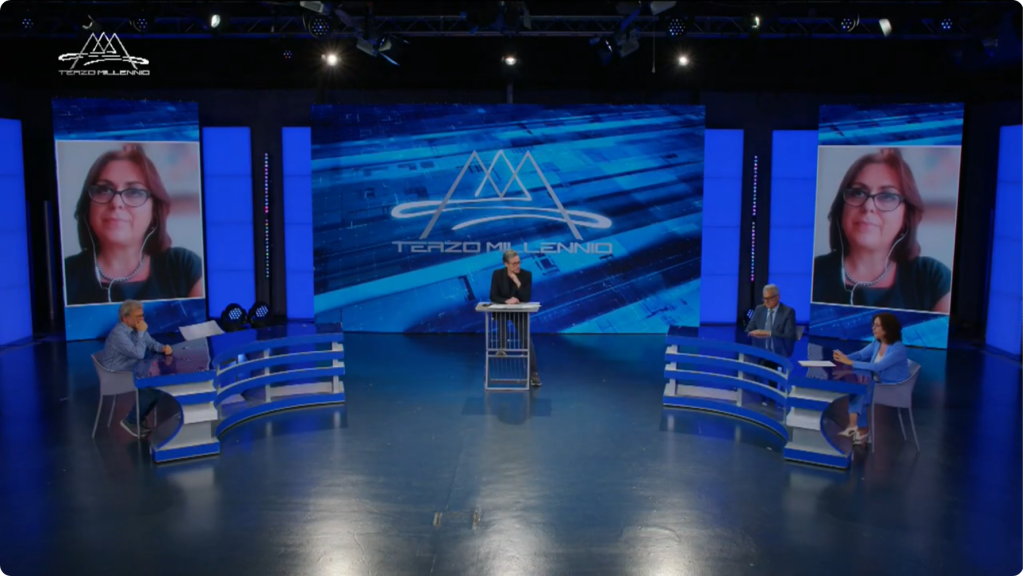

Elisa Amorelli on Terzo Millennio, a programme presented by Andrea Fragasso
Every day, we scroll through hundreds of pieces of content in just a few minutes. A news item, a video, an opinion, a historical account. But what happens to our relationship with memory, culture and information when it is increasingly an algorithm that decides what we see? This question formed the starting point for the episode of Terzo Millennio, a programme presented by Andrea Fragasso and produced by Smart People, which also featured Elisa Amorelli, communications and social marketing coordinator at the Fondazione Mondo Digitale ETS.
In her contribution, Elisa brought the discussion back to a key point: the speed with which young people use digital technology should not be confused with genuine competence. “Speed in the digital world is one thing,” she observes, “but awareness and critical thinking are quite another.” This is why the Foundation has been working for over twenty-five years to train young people in digital skills, but also to support the entire educational community, from schools to families, from teachers to local organisations.
The crux of the matter, Elisa explains, is not merely technical. Digital literacy is not limited to familiarity with social media platforms and languages, nor to the ability to produce content quickly. Rather, it means knowing how to interpret an algorithm, recognise fake news, distinguish false news from true news, and navigate the infosphere independently. It is here that a decisive part of citizenship is played out today.
The data also serve to make this challenge even more urgent. Elisa cites the latest Eurostat figures: young Italians remain below the European average in digital skills, at around 68 per cent compared to the EU average of 74 per cent. This gap confirms just how necessary it is to invest not only in access to tools, but also in the quality of training and the ability to explore content in depth.
According to Elisa, it is precisely this in-depth engagement that represents one of the greatest challenges. In an ecosystem dominated by swiping and rapid consumption, there is a risk of remaining on the surface. But technology, she emphasises, is not the problem in itself. On the contrary, it can become a great opportunity if used to foster emotional engagement and prepare young people to truly immerse themselves in cultural content.
To illustrate this possibility, Elisa cites the example of a project hosted at the Palestra dell’Innovazione, the Foundation’s space dedicated to technology and innovation: a programme on the Divine Comedy in the metaverse, designed to bring young people closer to a work that might otherwise seem distant, using languages more in tune with their own experiences. In this case, technology does not simplify the content to the point of stripping it of meaning, but acts as a gateway, a way to capture attention and encourage a richer exploration.
Towards the end of the discussion, Elisa reiterates a conviction that has always underpinned the Mondo Digitale Foundation’s work: technology is not the problem, because technology is merely the vessel; what really matters is the content. Social media, video mapping, artificial intelligence and immersive reality can be valuable tools if they help to foster autonomy, critical thinking and informed participation.
It is a vision that brings innovation and culture together. It is no coincidence that Elisa also refers to the legacy of Tullio De Mauro, who chaired the Foundation for over ten years, and to the issue of functional illiteracy: not merely the inability to read and write, but the difficulty in using reading, writing and numeracy to engage with society in an informed way.
It is precisely in this space, between cultural skills and digital tools, that the Foundation continues to operate, supporting citizens of all ages, ‘from 0 to 99 years old’, on a journey of growth that places the individual at the centre.