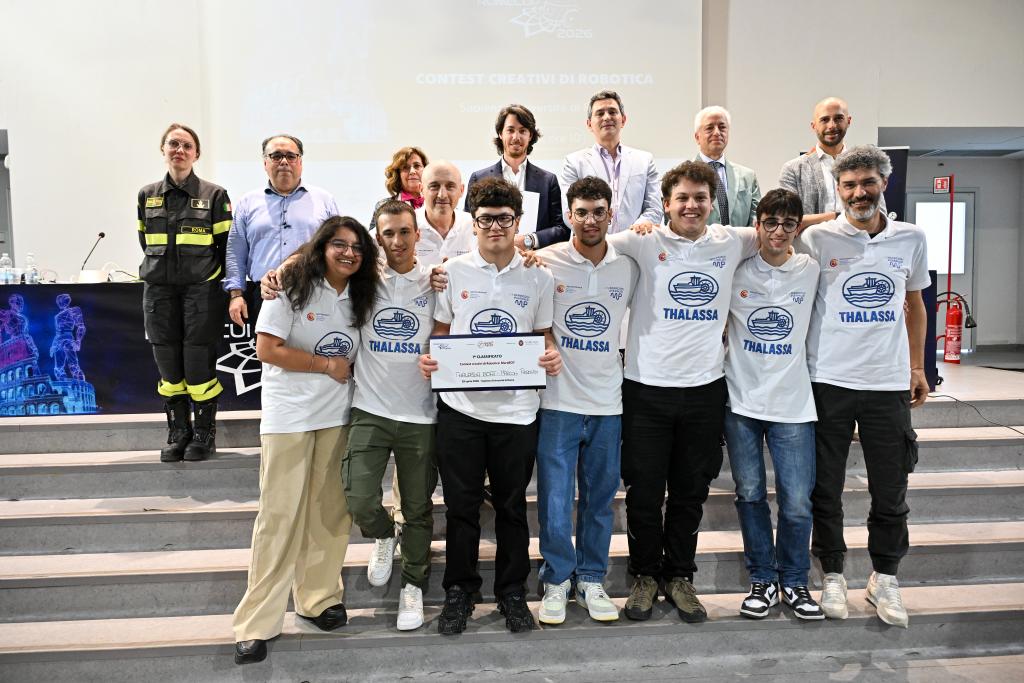

At RomeCup 2026, Marconi Pieralisi High School in Jesi takes first place in the MareBOT category
A radio-controlled catamaran, built from recyclable and reusable materials, capable of detecting plastic on the water’s surface, locating it via GPS and collecting it using an integrated mechanical system. It is Thalassa Boat, the project by the Marconi Pieralisi secondary school in Jesi (Ancona), winner of the MareBOT creative contest at RomeCup 2026, created with the support of the Politecnico delle Marche [see the news item Robotics that meets real needs].
The project emerged as an evolution of Calypso, the robot with which the same school had already won last year in the marine robotics category. Whilst Calypso was designed to monitor and detect floating waste using a camera with artificial intelligence, Thalassa goes a step further: it moves from detection to action, transforming into a comprehensive environmental intervention platform.
‘This year we took part with a robot capable of collecting waste from the water’s surface, mainly plastic waste,’ explains Mattia Vitali, one of the team’s students, in the video. ‘We created it with a green approach, using recyclable and reusable materials, without treating any materials to avoid further water pollution.’
Environmental considerations run through every stage of the project. Thalassa was developed by reusing components from previous robotic prototypes, in line with the principles of the circular economy. The decision not to apply paint or surface treatments stems from a desire to avoid releasing chemicals into the aquatic environment. Maintenance and end-of-life recycling were also taken into account right from the design stage.
From a technical perspective, the prototype incorporates a dual-camera vision system, control modules and electronic components housed within the hulls, a GPS system for locating collection points, and an automated device for waste recovery. At the heart of the system is a rotating drum that intercepts floating debris, lifts it out of the water and deposits it into an internal container. The design process progressed from brainstorming, sketches and 3D CAD modelling to the production of components using 3D printing, laser cutting and CAD-CAM systems. Buoyancy tests were then carried out to verify stability, weight distribution and load capacity.
‘The robots presented at the contest were all characterised by high technical content and were professionally very sound,’ writes the supervising lecturer Giuliano Fattorini (Laboratory of Design and Mechatronic Systems) on his Facebook profile. ‘To emerge as winners, in addition to the prototype’s soundness, the accuracy of the drawings and precision in the development and construction of the model, a touch of luck was also required. The fact remains that the students on the Mechatronics course have once again proven themselves to be at the top of the MareBOT category.’
The project began in September with the Blu Deep project, funded by PNRR grants, which involved third- and fourth-year students on the Mechatronics course. The prototype was then further developed by the fourth-year classes and refined in all its aspects by the fifth-year students.
The competition was entered by Preet Kaur, Cristiano Carbonari, Manuel Maffei, Mattia Vitali from 5th MM, and Alessandro Manoni and Andrea Valeri from 5th NM.
‘The young people who represented Marconi Pieralisi are the tip of an educational iceberg,’ emphasises headteacher Maria Rita Fiordelmondo in the news item published on the school’s website. “The context of the study programmes that characterise our offering has enabled us to achieve a result of excellence. As with any idea that is conceived and takes shape into something concrete, credit must also be shared with the local businesses that make a fundamental contribution.”
With Thalassa, the MareBOT category confirms the educational value of RomeCup’s creative contests: not just technological competitions, but workshops where young people learn to transform technical knowledge, environmental awareness and teamwork into concrete solutions for real-world problems. As the project presentation states: “Let’s clean up the sea, one wave at a time”.