
University talks, discussions between partners and a creative contest
At RomeCup 2026 (28–30 April), the DIGA project transformed career guidance into a hands-on experience of discovery, discussion and design. The four partner universities took part in the event with a series of talks aimed at secondary school students, focusing on some of the key challenges and opportunities linked to digital technology: from a human-centred approach to computer science and artificial intelligence, from cybersecurity to robotics, right through to assistive technologies.
The University of Turin explored the theme of human-centred computing; the University of Milan guided students into the world of hackers, AI and the professions of the future; the University of Padua presented applications of artificial intelligence and robotics for assistive technologies; Roma Tre University, together with the Automation and Robotics Group, explained how intelligence can ‘take shape’ in robots operating in the real world.
Alongside the career guidance sessions, RomeCup also provided an opportunity for collaboration among the project partners. Universities, schools and the Fondazione Mondo Digitale shared approaches, methodologies and best practices developed locally: from student training to teacher engagement, right through to building educational communities capable of supporting young people in their educational and career choices.
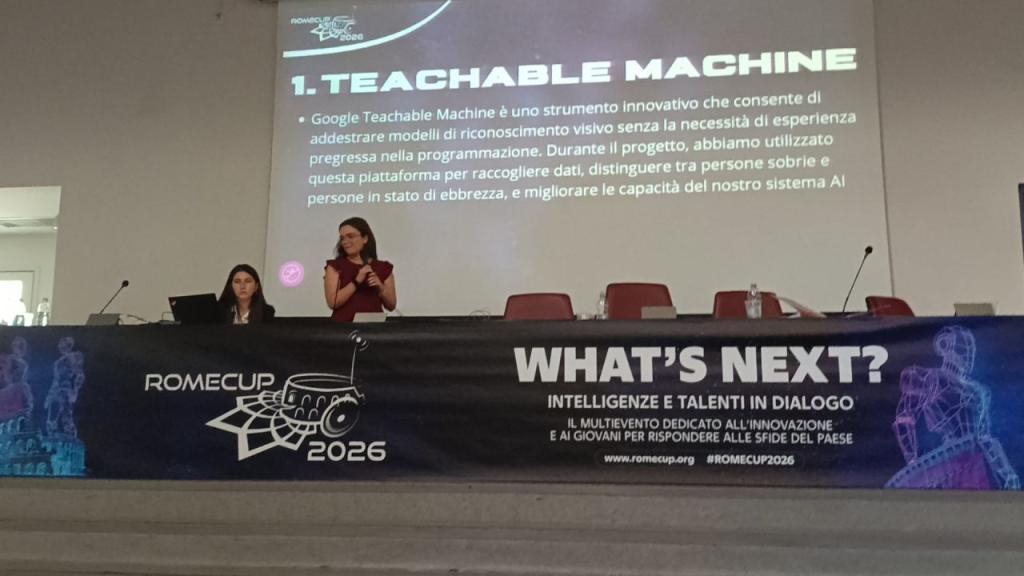
The programme reached a particularly significant milestone with the participation of the Roman high schools Teresa Gullace Talotta and Gaetano De Sanctis in the creative robotics contest in the Tirbot category, dedicated to autonomous vehicles and systems for safe mobility. The students presented the prototypes developed during the school-work training programmes in the main lecture theatre at Sapienza University, in front of an audience of peers and a jury of experts [see the news item ‘Robotics that meets real needs’].
The winner of the category was the ‘Road Safety and AI’ project from Gaetano De Sanctis High School, carried out with the support of Roma Tre University. The prototype uses artificial intelligence to recognise possible signs of driver impairment, such as drowsiness or intoxication, and trigger an audible alarm, with the aim of preventing risky driving situations.
In the video interview, students Chiara Bodo and Chiara De Santis, representing classes 4FS and 4AS of the De Sanctis Scientific High School, describe the work carried out: a model based on Teachable Machine to distinguish between sober and intoxicated individuals, connected to an Arduino circuit capable of activating an alarm and preventing the engine from starting in the event of a risk. The team’s presentation describes the process as an experience divided between training, at Roma Tre University, and practical work, at the Fondazione Mondo Digitale, involving activities on artificial intelligence, electronic circuits, Teachable Machine and Tinkercad.
“Our project focused on using Teachable Machine to distinguish between intoxicated and sober individuals,” explain the students. “By connecting this artificial intelligence to an Arduino circuit, an alarm is triggered that also prevents the engine from starting if the system detects a risky situation.”
The project, developed as an educational and prototypical initiative, demonstrates how career guidance can become an active experience: not merely learning about technologies, but using them to devise solutions to real-world problems. This is one of DIGA’s objectives: to introduce students to digital disciplines through pathways that bring together universities, schools, research and practical applications, helping the younger generation to recognise the digital sphere not merely as a field of study, but as a space for responsibility, creativity and the future.