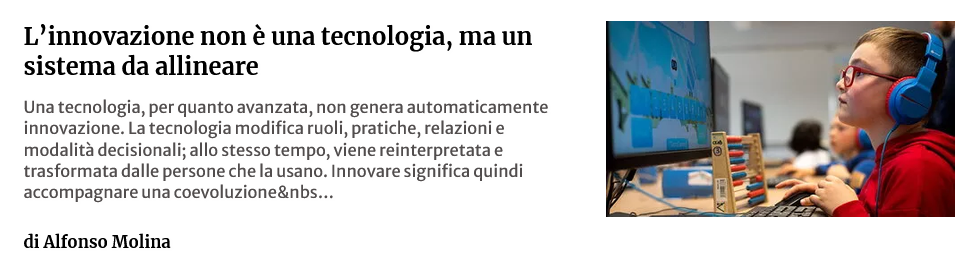

On the HuffPost blog, Alfonso Molina offers a socio-technical perspective on innovation
No matter how advanced it may be, technology does not automatically lead to innovation. To have a real impact in the contexts in which it is introduced, it must engage with people, organisations, rules, skills and social objectives.
This is the central theme of the new article by Alfonso Molina, co-founder and scientific director of the Fondazione Mondo Digitale, published on the HuffPost blog under the title “Innovation is not a technology, but a system to be aligned”.
In the post, Molina urges us to move beyond a view of innovation that focuses exclusively on the device, the algorithm or the platform. Innovation is, instead, a socio-technical process, arising from the interaction between technological and social components: knowledge, people, infrastructure, organisational cultures, resources, rules and needs.
An artificial intelligence system applied to healthcare, for example, cannot be assessed solely on the basis of the algorithm’s accuracy. Its effectiveness also depends on the quality of the data, its integration into clinical processes, the skills of healthcare professionals, the distribution of responsibilities and patients’ trust. The same principle applies in education, industry, public administration and social services.
Technology changes practices, roles, relationships and decision-making processes, but is in turn reinterpreted by the people who use it. Innovation therefore means facilitating a co-evolution, seeking a dynamic balance between the various components of the system.
From value chains to learning ecosystems
The article also proposes moving beyond the linear model of technology transfer, which ideally leads from the university to the business and then to the market. The major contemporary challenges – from health to sustainability, from an ageing population to inclusion – require collaboration between disciplines, organisations and communities right from the earliest stages of research.
An innovation ecosystem is not merely a group of actors gathered around a project, but a network capable of learning. Universities, businesses, institutions, civil society, schools and citizens pool their diverse knowledge and experiences, helping to redefine both the problems and the possible solutions.
From this perspective, innovation does not mean transferring a technology that has already been developed, but co-creating knowledge and steering its development towards socially desirable outcomes.
Research as an open process
A concrete example is the RomeCup Research Award, which highlights the process through which research is progressively transformed into innovation. The solutions submitted in the fields of robotics and artificial intelligence are assessed not only on the basis of the scientific results achieved, but also on the ability of young researchers to explain the problem addressed, the design choices made and the potential implications to different audiences.
Engagement with experts, businesses, institutions, schools and members of the public also enables a prototype still under development to encounter new expertise, reveal limitations and generate questions capable of altering its trajectory. Applications are open until 28 February 2027 for the new edition of the Most Promising Researcher in Robotics and Artificial Intelligence award, organised by the Fondazione Mondo Digitale in collaboration with the Campus Bio-Medico University of Rome. The award, worth 20,000 euros, will be presented on 15 April 2027 during the RomeCup.
Supporting a young researcher means investing not only in a person or a technology, but in the connections that can transform knowledge into a collective capacity for change.
Read Alfonso Molina’s article on the HuffPost blog.