
Roll Cloud: at Roma Tre, ideas that put AI at the service of people
Putting artificial intelligence at the service of the most vulnerable, transforming technical skills into practical solutions for everyday life. This was the challenge that brought the classrooms of the Department of Civil, Computer and Aeronautical Engineering (DICITA) at the University of Roma Tre to life on 23 March. This is where the first stage of Roll Cloud. Working in the Cloud kicked off, an initiative promoted by the Fondazione Mondo Digitale as part of Opening Future, a joint project by Google Cloud, Intesa Sanpaolo and TIM Enterprise. The absolute protagonists: the students, called upon not only to design, but to imagine a future in which technology bridges distances and strengthens care.
Beyond the technical: skills that make the difference
During the hackathon, participants put their collaboration, listening and problem-solving skills to the test, transforming individual ideas into shared visions. As Professor Federica Pascucci emphasised, initiatives such as this allow students to broaden their soft skills, learning to work in a team and to communicate their solutions effectively.
The words of the Null Pointers team (Stefano Zerbino, Dario Nicchi, Andrew John John Murugan and Patryk Rea) sum it up well: “Through discussion, we managed to create a better product than we had imagined individually: four brains definitely work better than one.”
Three ideas, one goal: a more humane healthcare system
Three projects emerged from the challenge that stood out for their innovation and social impact, securing a place in the national final of the Rome Cup 2026, scheduled for 28 April at La Sapienza University.
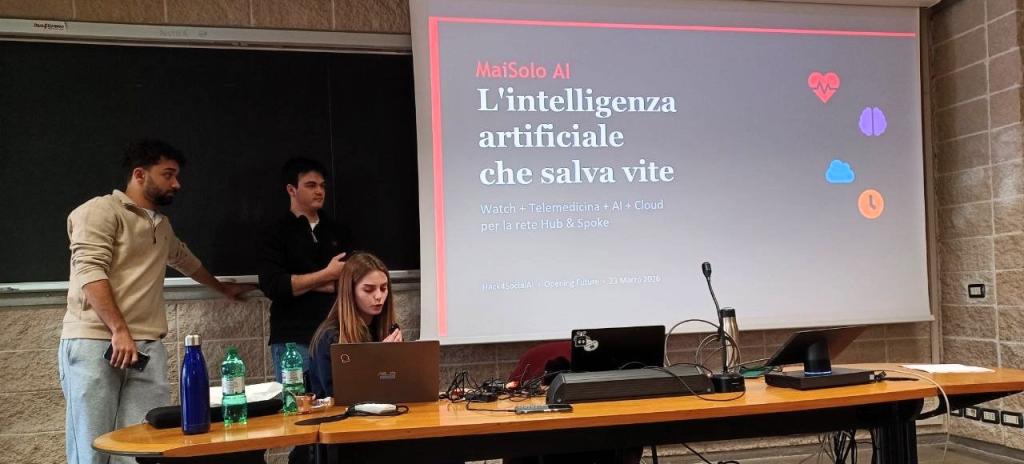
MaiSolo AI (winning team)
Developed by Gabriele Crociani, Alessandro Pasetti and Alessia Castagnedi, the project stems from a simple yet profound need: never to leave people alone in their most critical moments. The system integrates a smartwatch and an app for continuous monitoring of vital signs, but its key strength lies in the use of predictive AI. Thanks to the F.A.S.T. protocol and facial recognition, it is able to detect signs of a stroke within seconds. The app also includes emotional support features, such as voice tone analysis to identify situations of vulnerability.
CareGuardianAI (CareMinds team)
Camilla Cozzolino and Federica Piccardi’s project reimagines home care through a smart wheelchair equipped with IoT sensors and wearable devices. It does not merely collect data, but transforms it into useful information for carers and family members, facilitating timely decisions and improving the safety of elderly people or those with disabilities.
Clinical Pointers (Null Pointers team)
A platform designed to simplify the work of healthcare staff by reducing the administrative burden.
Thanks to the ‘voice-to-log’ function, doctors and nurses can record voice notes that are automatically transcribed, organised and summarised, improving the continuity of information between shifts and leaving more time for patient care. Supporting the students’ journey is also the contribution of Opening Future’s partners, who have accompanied the challenge with a shared vision: putting innovation at the service of people.
“Today, understanding the limits, risks and opportunities of artificial intelligence is crucial, especially in high-impact applications such as those in the healthcare sector, which is why it is important to consider ethical aspects as well. The teams of students tackled the challenge with determination, great creativity and a focus on privacy, security and human-centredness.”
Marta Casassa, Service Concepts & Innovation, TIM Enterprise
“It was a valuable opportunity to see how the younger generations are highly attuned to social issues, such as physical and mental health and, more generally, vulnerability, and are able to devise innovative solutions that serve people, without ever sidelining the centrality of the human being in decision-making processes.”
Rebecca Ascalone, Diversity, Belonging & Inclusion, TIM
“In an Italy where the median age has reached 48.6 years and the chronic burden weighs on an increasingly strained system, AI is not just an option, but a necessity to ensure sustainability. Technological innovation, which is becoming ever faster and more specialised, must go hand in hand with humanisation—such as, for example, using advanced algorithms to free up time to devote to listening and empathy. During RollCloud, I was able to tell those present about the important initiatives in the ‘health’ sector that Intesa Sanpaolo supports through its social initiatives. I saw young university students designing solutions that place the person, and not just the data, at the centre of care. The expectation and objective therefore become to transform the demographic challenge into an opportunity for civil and healthcare renewal”.
Cristiana Bellinazzi, Learning Design & Instructional Training, Intesa Sanpaolo per il Sociale


