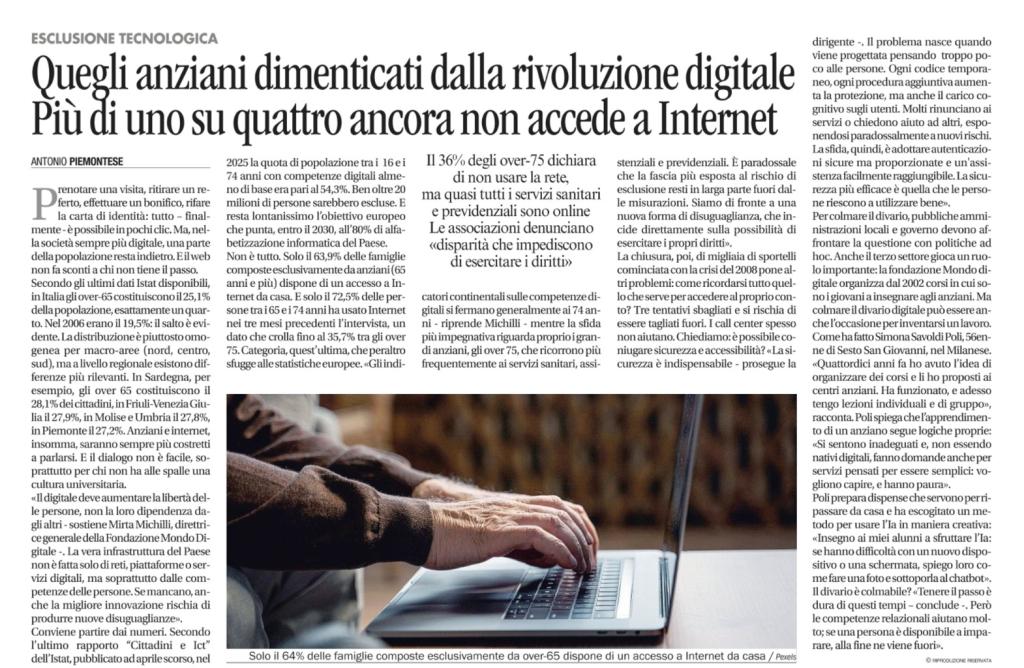

An interview with Mirta Michilli in *Avvenire* on the digital divide that still excludes a significant proportion of the elderly population from essential services
Booking a doctor’s appointment, viewing medical reports, accessing a bank account, using public administration services: these are activities increasingly carried out via online platforms and procedures. But what happens when the skills needed to use them are not within everyone’s reach?
This is the issue addressed by Antonio Piemontese in the newspaper Avvenire, in the article “Those older people forgotten by the digital revolution. More than one in four still do not have internet access”, published on 19 August, which also features a contribution from Mirta Michilli, Director-General of the Fondazione Mondo Digitale.
The figures reveal a gap that remains significant. According to the latest Istat report “Citizens and ICT”, by 2025 only 54.3 per cent of the population aged between 16 and 74 will possess at least basic digital skills, whilst the European target set for 2030 is 80 per cent. Among households comprising exclusively people aged 65 or over, only 63.9 per cent have internet access at home. And whilst 72.5 per cent of those aged between 65 and 74 had used the internet in the three months prior to the survey, this figure drops to 35.7 per cent among the over-75s.
This is a particularly significant figure precisely because those aged over 75, despite being among the citizens who make the most frequent use of health, care and social security services, generally remain excluded from European indicators on digital skills.
“Digital technology must increase people’s freedom, not their dependence on others. The country’s true infrastructure consists not only of networks, platforms or digital services, but above all of people’s skills. If these are lacking, even the best innovation risks creating new inequalities,” emphasises Mirta Michilli. The issue therefore concerns not only access to technology, but the practical ability to exercise rights and maintain autonomy in a society where more and more services are becoming digital.
Security and accessibility must also go hand in hand. Complex authentication procedures, one-off codes and additional steps may increase protection, but at the same time become obstacles for those less familiar with digital tools.
“Security is essential. The problem arises when it is designed with too little thought for people,” observes Michilli in the interview. “Every one-off code, every additional procedure increases protection, but also the cognitive load on users. Many give up on services or ask others for help, paradoxically exposing themselves to new risks.”
The solution therefore lies in more accessible services, easily available support and, above all, ongoing investment in skills.
This is a challenge that the Fondazione Mondo Digitale has been tackling since 2002, when it launched Nonni su Internet, the intergenerational digital literacy programme that has led thousands of students to become tutors for older citizens. A model conceived over twenty years ago and still relevant today: not to take the place of people, but to support them so that they can gain autonomy, confidence and trust in using technology. Because innovation is truly inclusive only when no one is forced to depend on someone else to exercise their own rights.