Lara Fina Ferrari presents an educational pilot project in Padua, developed as part of a training programme with the Fondazione Mondo Digitale
From training to classroom experimentation, right through to sharing the results with the scientific community. This is the journey of Lara Fina Ferrari, a teacher at the Vergante Comprehensive School, at the Invorio campus (Novara), who presented her experience of artificial intelligence literacy at Didamatica 2026, the conference dedicated to digital innovation in schools, held in Padua on 7 and 8 October.
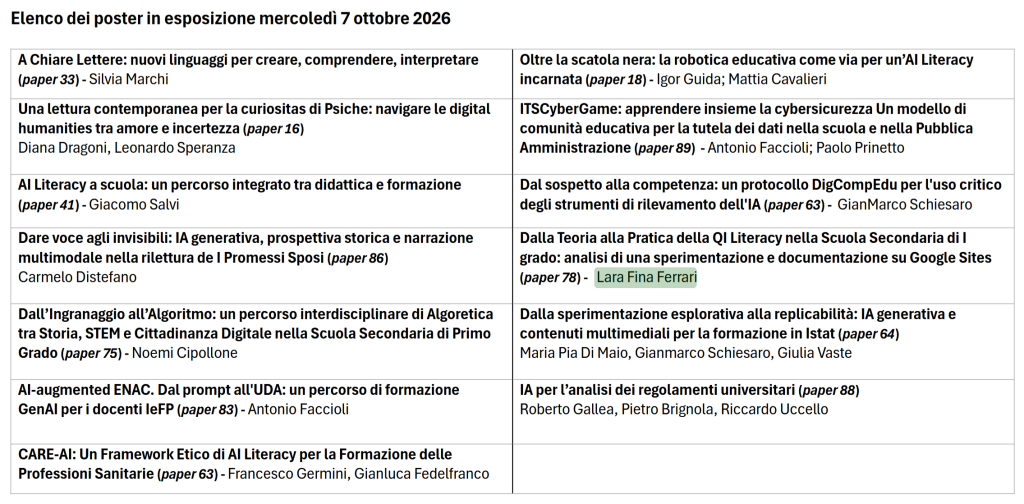
Her contribution, entitled From Theory to Practice of AI Literacy in Lower Secondary Schools: Analysis of a Pilot Study and Documentation on Google Sites, was well received and presented during the event in the form of a scientific poster.
This professional achievement was one that Lara wished to share with the Fondazione Mondo Digitale, recognising the training programme they undertook together as the starting point for her pilot study and reflection on the educational use of artificial intelligence.
Shakespeare Meets Artificial Intelligence
During the 2025–2026 school year, Lara involved a Year 3 class at a lower secondary school in an interdisciplinary project combining digital skills, English, literature and creativity.
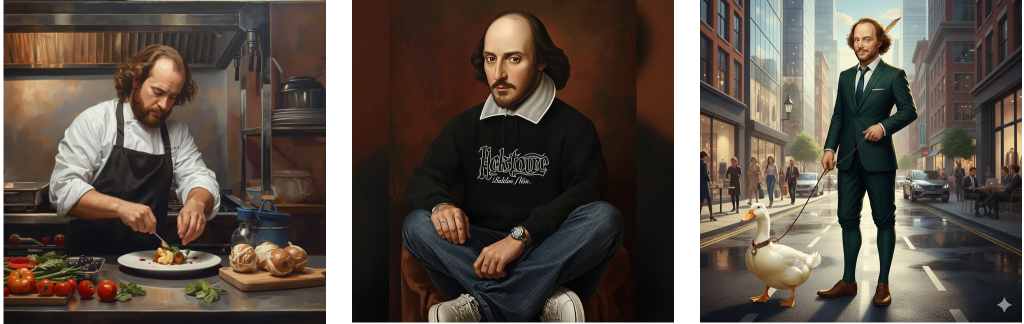
After an initial phase focused on understanding how AI works, the pupils set themselves two creative challenges centred on William Shakespeare. In the first, they used instructions in English to generate portraits of the playwright, paying close attention to historical details and physical descriptions. In the second, they tried to imagine what Shakespeare might look like if he were alive today, using Canva’s generative AI tools.
And so we see Shakespeare in a hoodie and gaming headphones, in a tracksuit whilst checking his smartphone, or in Renaissance attire on a tropical beach, wearing purple sunglasses and flashy gold chains. Some imagine him as a chef in a Michelin-starred restaurant, others strolling through the city with a white goose on a lead, and others taking a selfie in the garden with his dog. These surprising, ironic and personal interpretations also reveal the teenagers’ perspective on contemporary life. Each image is accompanied by a description in English, focusing on physical features, clothing and accessories. The creative work thus becomes an opportunity to practise vocabulary, construct accurate descriptions and reflect on the relationship between the instructions provided and the results generated by artificial intelligence. The activities were also supplemented with pronunciation exercises and the recitation of famous Shakespearean quotations.
All the work is collected on the class website, which documents the various stages of the experiment. A small digital gallery that showcases the variety of interpretations and the students’ active involvement.
Discover Shakespeare through our eyes
From experimentation to educational research
The experience was accompanied by tools for observing and self-assessing digital and linguistic skills. In the paper presented at Didamatica, the teacher documents the progress observed in understanding how AI works, in the accuracy of descriptions in English, in oral expression and in the ability to critically re-evaluate content. At the heart of the experiment lies a specific educational principle: artificial intelligence can become an opportunity to strengthen human skills, from creativity to judgement, from linguistic awareness to ethical reflection. Lara’s story also shows how teacher training can generate new educational practices, capable of developing independently, being documented and becoming the shared heritage of the school community.
This is an outcome that makes us particularly happy, as it illustrates the value of a formative relationship that continues to generate knowledge, experimentation and new learning opportunities.
Lara is also one of the key figures in the community of Teachers of the ‘School of Us’. In the testimonial published last June, she described how much her interactions with other teachers and with the Fondazione Mondo Digitale had contributed to her professional development. The presentation at Didamatica now represents a new milestone in that journey, which moves from the sharing of experiences to the generation of knowledge and its dissemination within the educational community.