
Loris Cecchini’s works at the Botanical Gardens in Milan and Rome
An artistic and cultural project developed in collaboration with the University of Milan, the Brera Academy of Fine Arts, Sapienza University of Rome and the Fondazione Mondo Digitale. Four monumental sculptures create a dialogue between art, science, nature and society, opening up new paths of knowledge for the public.
What form do relationships take? And how can art and science help us to observe the processes through which simple elements connect and give rise to complex systems? It is around these questions that ‘Knowledge that Connects’ was conceived – the artistic and cultural project bringing the works of Loris Cecchini to the Botanical Gardens of Milan and Rome. A project developed through collaboration between Fondazione Mondo Digitale, University of Milan, Brera Academy of Fine Arts and Sapienza University of Rome, curated by Valentino Catricalà.
At the heart of the project are the modular sculptures by Loris Cecchini, an Italian artist with an established international presence. In his work, the module is a relational unit: a minimal form which, by connecting with others, generates complex structures. The works draw on models from biology, physics and the theory of complex systems, in which organisation emerges from the interactions between parts. The four groups of works selected for the project develop this principle in different ways: Waterbones explores elementary connection; Sequential Interactions in Alfalfa Chorus explores cooperation; Arborexence explores branching; Airborne explores propagation in space. Viewed together, they form a journey that extends from the bond between individual elements to the formation of systems capable of growing, transforming and finding new directions.
The choice of botanical gardens brings this research into living scientific collections. Cecchini’s metal structures interact with plants, trees, flowerbeds and paths, creating a dialogue between artificial and natural forms. The artist works, in fact, on the principles of organisation and transformation in nature: his sculptures reveal the relationships and processes that underpin natural systems and complex forms.
A project developed in collaboration with universities
“Knowledge that connects” stems from a collaborative design process between the University of Milan, the Brera Academy of Fine Arts, Sapienza University of Rome and the Fondazione Mondo Digitale, which have jointly developed the project by bringing together different areas of expertise and perspectives: research, education and the ‘Third Mission’; research and artistic experimentation; education, technological innovation and social inclusion. At the Brera Botanical Garden and subsequently at the Rome Botanical Garden, four sculptures by Cecchini are positioned at different points within the garden according to a plan devised by the artist’s studio, taking into account the historic flowerbeds, trees and visitor pathways. The works thus form a widespread system that guides visitors through various ways in which the module is organised and transformed. A programme of tours and activities aimed at the university community, schools and the general public is being organised around the works. For universities, the project forms part of the Third Mission activities, which link research, the dissemination of culture and the local area.
From Milan to Rome
The programme includes a private preview on Thursday 15 October in Milan, with the unveiling of the works at the Brera Botanical Garden. The presentation will be followed by an in-depth discussion on the cultural value of the project with academics, the artist and the curator. The day continues at the former church of San Carpoforo, a venue belonging to the Brera Academy of Fine Arts, with a gathering of the key figures and the communities involved in the project. From 16 to 18 October, the Botanical Garden will be open to the university community, schools, the general public and families, with dedicated tours and activities.
In Rome, “Knowledge that Connects” continues from 21 to 25 October at the Rome Botanical Garden, managed by Sapienza University of Rome, and the Fondazione Mondo Digitale’s Palestra dell’Innovazione, in the south-east of the capital. On 21 October, the programme will open discussions with institutions and the business world through the conference ‘The Impact of Digital Technology on the Social Economy’, organised in collaboration with the Terzjus Foundation, and an invitation-only reception hosted by the Deputy Chief of Mission at the Embassy of the United States of America in Italy, at Villa Pinciana. Friday 23 October, the Botanical Gardens will host the unveiling of Cecchini’s artwork. The programme then moves to the Palestra dell’Innovazione, at 102 Via del Quadraro, which, over the weekend of 24 and 25 October, will open its doors to the community with workshops and educational activities aimed at families and the general public.
Some workshops for schools in both cities are being run in collaboration with Unidata, a company specialising in the design and implementation of telecommunications networks and infrastructure, with the direct involvement of its experts. This marks the company’s first skills-based volunteering initiative, with professionals making their knowledge and experience available to the young participants.
Curatorship
The project is curated by Valentino Catricalà, a contemporary art curator and artistic director. The collaboration with Fondazione Mondo Digitale stems from work developed over the years through the Arte e Media programmes and the Rome Media Art Festival, founded by Catricalà with the Foundation’s support and subsequently hosted by the MAXXI.
Giving back to the community
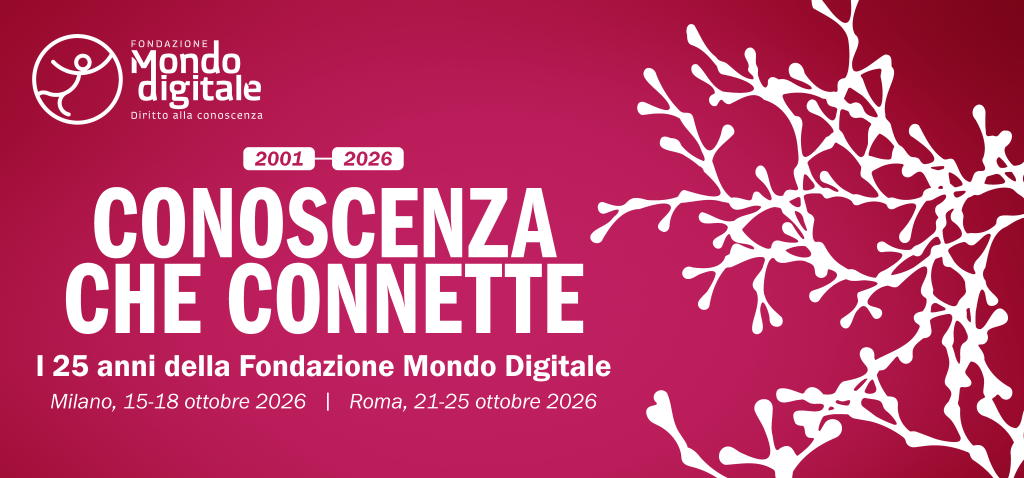
The public dimension is an integral part of “Knowledge that Connects”. Guided tours and in-depth activities open up the artworks to students, schools, families and members of the public, transforming the artistic experience into an opportunity for observation, interpretation and the sharing of knowledge. It is also in this context that the ‘Third Mission’ of universities and the Fondazione Mondo Digitale’s social innovation converge: linking knowledge and skills with local areas and communities, generating new opportunities for learning and participation. The project also marks the 25th anniversary of the Fondazione Mondo Digitale and serves as a way of giving back to the communities that have shared this journey. Since 2001, the Foundation has been building relationships between schools, universities, businesses, institutions, social organisations and citizens. Cecchini’s modular structures also offer a visual representation of this process: they make visible an impact that arises from relationships, generates new connections and spreads over time.