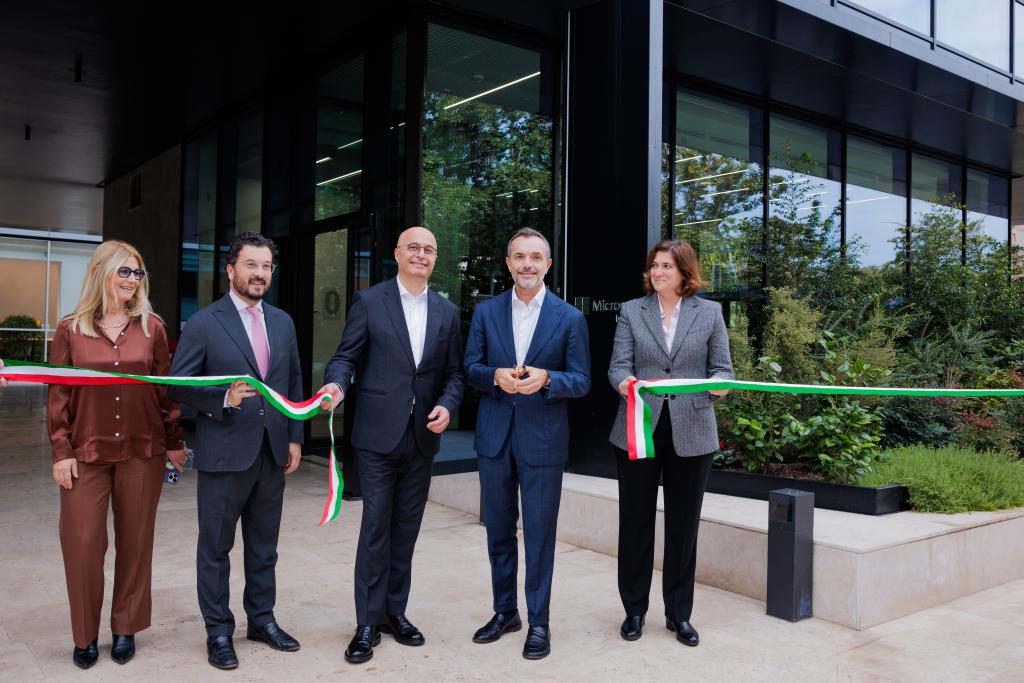
At the Microsoft Pavilion in Rome, which opened yesterday in the EUR district, the partnership with Microsoft for school-based training has been renewed
A first-year class from the Enzo Ferrari Institute in Rome, specialising in IT, taking part in a cybersecurity workshop. This is one of the most significant images from the opening of the Microsoft Pavilion, the new Rome headquarters of Microsoft Italia, which opened yesterday, 11 November, in the heart of the EUR district. Whilst representatives from institutions, businesses and the world of innovation attended the opening ceremony, the students were experiencing first-hand some of the activities from the Smart & Safe programme, developed by the Fondazione Mondo Digitale in collaboration with Microsoft.
The decision to involve a school in the opening of a venue dedicated to innovation also highlights the value of a partnership that has been ongoing for over twenty years, with the aim of making digital skills accessible to all.
The new Microsoft Pavilion is housed in the former NATO Pavilion, a historic building dating from 1942 that has been completely refurbished and is now intended to host collaborative activities, training and experimentation on cloud technologies and artificial intelligence. The inaugural press conference was also attended by Mirta Michilli, Director General of the Fondazione Mondo Digitale ETS, alongside representatives from Microsoft Italy, the institutions and the partners involved in the project.
“Our collaboration with Microsoft has underpinned our commitment to making digital skills accessible to everyone for over twenty years. For the Fondazione Mondo Digitale, founded in Rome twenty-five years ago, it is particularly significant that the opening of this new venue begins with a training programme aimed at students,” emphasised Mirta Michilli.
Cybersecurity starts in the classroom
During the special session of Smart & Safe, pupils from the IIS Enzo Ferrari explored the topics of online safety, discussing the steps to take to protect accounts and personal information, recognise digital scams and address the risks associated with the use of artificial intelligence.
“The session sparked curiosity and active participation. Some pupils also asked to find out more about career opportunities in cybersecurity, demonstrating how a workshop dedicated to digital security can serve as a pathway towards new skills and professions,” explained project officer Martina Panunzio. The opening also marked the launch of the new edition of Smart & Safe. The programme will involve 4,000 students across Italy through 90-minute interactive sessions, both in person and online, led by Microsoft volunteers. The activities address, through examples and practical case studies, account protection, phishing, artificial intelligence and deepfakes.
A community of teachers to share expertise
To mark the opening of the new centre, the partnership between Microsoft Italy and Fondazione Mondo Digitale was also renewed through the Ital.IA Lab Community for Educators programme, dedicated to teacher training and the creation of a professional community focused on the responsible use of artificial intelligence in education. The initiative forms part of the Microsoft Elevate for Educators ecosystem and provides teachers with training resources, opportunities for discussion, events and chances to collaborate. The programme will also contribute to the activities of the Digital Licence for Teachers and will culminate in a national challenge on educational innovation, to be held during the RomeCup 2027.
“Today, in the face of the transformations brought about by artificial intelligence, we need teachers capable of interpreting change and guiding the younger generations with expertise and a critical mindset.
With the Ital.IA Lab Community for Educators, we want to invest in the collective dimension of teaching professionalism: a community where teachers share experiences, discuss teaching practices and contribute to improving their colleagues’ work. Because a school capable of facing the challenges of the future is, first and foremost, a school capable of learning from its own experiences,” added Mirta Michilli.
The opening of the Microsoft Pavilion thus brought together two complementary aspects of collaboration: the education of young people and the development of teachers’ skills. On the one hand, students grappling with real-world digital security issues; on the other, a professional community committed to sharing practices and tools to foster innovation in schools.
Two approaches that contribute to the same goal: equipping the younger generation with the skills to understand technological transformations, seize the opportunities they present, and participate meaningfully in the digital society.