
The Sapienza team: research at the intersection of artificial intelligence, autonomy and collaboration
Whilst international attention is focused on the 2026 FIFA World Cup – and Italy is not on the pitch this time round – there is another form of football in which Italian research is very much present: the game played by autonomous robots, where every pass, every movement and every tactical decision stems from the interplay between artificial intelligence, computer vision, motor control and cooperation between systems.
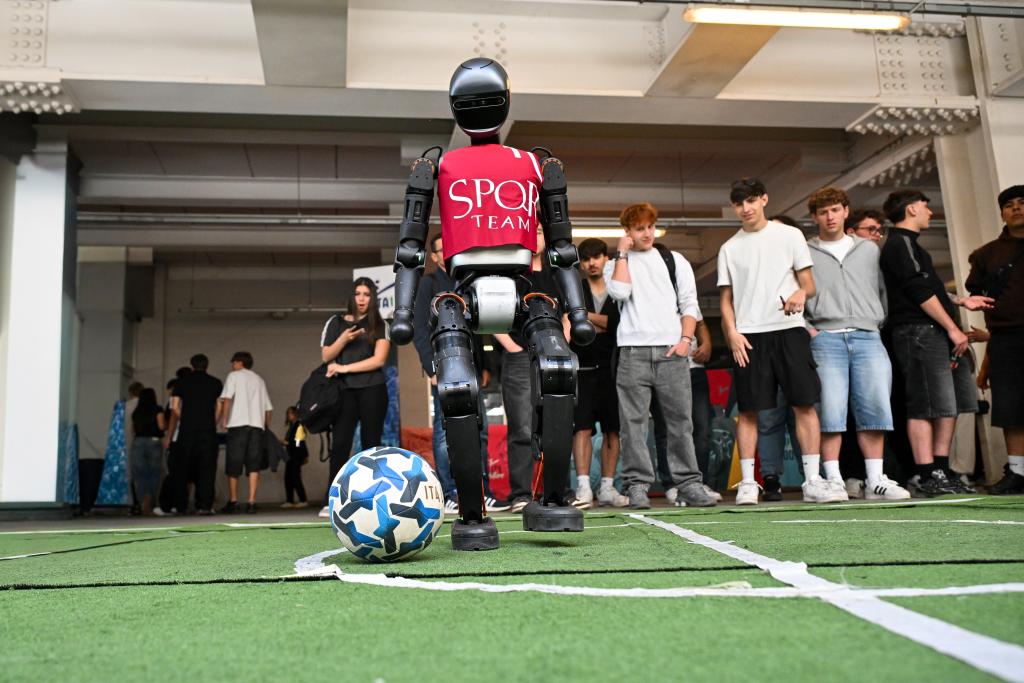
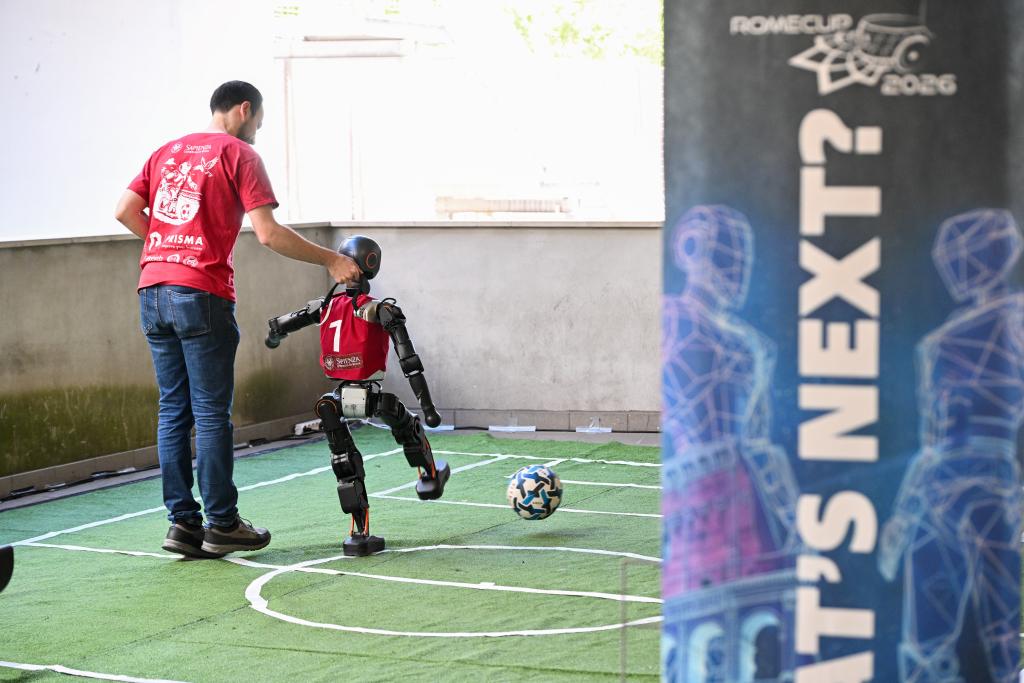
At the RomeCup 2026, which took place last April, we met the key figures behind the robot footballers project at Sapienza University of Rome: the robot Virgilio, researcher Vincenzo Suriani and Professor Luca Iocchi, one of the leading figures in Italian robotics.
“For me, playing football is my mission,” says Virgilio in the interview. “Every movement is calculated and every match is a challenge of strategy and precision.”
Behind the apparent light-heartedness of a match between robots lies complex research. The robots must move around the pitch, recognise the ball, orientate themselves in space, communicate with their teammates, decide on the best strategy in real time and correct their mistakes. Each match thus becomes a testing ground for technologies relating to perception, learning, autonomy, coordination and interaction with the physical world.
“Each robot has a specific role and our artificial intelligence decides on the best moves in real time,” explains Virgilio. “It’s all about striking a balance between tactics, speed and precision.” Even mistakes are part of the process: a misplaced pass or a missed goal provide useful data for refining movements and strategies.
Vincenzo Suriani, a researcher at Sapienza University, highlights the scientific value of the challenge. RoboCup’s international goal is ambitious: to stage a match by 2050 between autonomous humanoid robots and FIFA world champions. A visionary prospect, which nevertheless serves to drive forward research into robotics and artificial intelligence.
“How much research went into creating Virgilio? A great deal,” explains Suriani. “The project has been running since 1997, so imagine how much it has already achieved. And this then feeds into all our other activities, because the transfer of technology is very significant.”
Robotic football, in fact, is not an end in itself. It is a research platform where solutions are tested that can be applied in many other fields: collaborative robots, assistance, logistics, exploration, security, environmental monitoring, and autonomous systems capable of operating in complex contexts.
Luca Iocchi, full professor of Artificial Intelligence and Robotics at Sapienza University, also highlights this, emphasising the value of the RomeCup as a space where young people can see technology in action. “The RomeCup is a perfect event,” he explains, “because alongside discussions and conferences, it allows students to understand what artificial intelligence and robotics are through workshops, demonstrations and hands-on experiences.”
At a time when young people are questioning their future and the relationship between people and technology, robot footballers become more than just a scientific curiosity. They demonstrate that artificial intelligence is not just about language or content generation, but can involve movement, decision-making, cooperation, error, learning and interaction with the environment.
The interviews conducted at RomeCup 2026 thus shed light on Italian research that uses the game of football as an advanced laboratory to explore the future of robotics. They also remind us that, just as in sport, progress in science is made one choice at a time: by observing, trying, making mistakes, correcting them and getting back on the pitch.