
Applications are open until 10 September for the competition organised in partnership with ING Italia as part of the Job Digital Lab
Technology capable of restoring independence, facilitating communication, making an environment accessible, or enabling greater participation in school, professional and social life. Solutions of this kind already exist, often developed by young researchers, start-ups, associations and interdisciplinary groups. However, they do not always manage to gain the visibility, recognition and opportunities needed to grow.
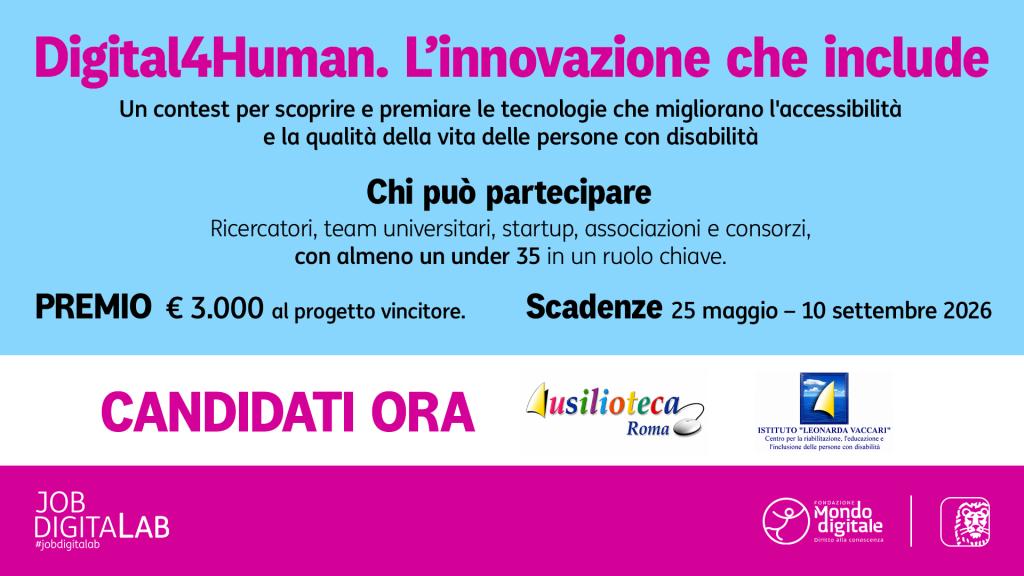
was created to showcase these initiatives. ‘Innovation that includes’, the competition organised by the Fondazione Mondo Digitale ETS and ING Italia as part of the Job Digital Lab programme, with the participation of Ausilioteca Roma and the Istituto Leonarda Vaccari, two leading organisations in the field of disability and inclusion.
Entries are open until 10 September 2026. The winning project will be awarded a prize of 3,000 euros.
From ideas to solutions already in use
Almost 2.9 million people with disabilities live in Italy, accounting for around 5 per cent of the population. For many of them, access to digital and assistive technologies is essential for fully exercising their right to education, work, communication and social participation. The potential for innovation is vast: artificial intelligence systems that facilitate communication for people with motor or speech disabilities; tools to reduce noise interference and support neurodivergent workers; and smart devices, sensors and robots capable of assisting with daily, educational or rehabilitative activities. At the same time, the access gap remains significant. According to the global report on assistive technologies published by the World Health Organisation and UNICEF, over 2.5 billion people worldwide are estimated to need at least one such tool, yet nearly one billion are unable to access them. Digital4Human is therefore seeking concrete projects: working prototypes, beta versions or solutions that have already been trialled in real-world settings such as schools, homes, workplaces or communities. The direct involvement of people with disabilities for whom the technology is intended is required. Proposals that are still at the idea stage or at the stage of mere conceptual development will not be accepted. Candidate technologies may range from artificial intelligence to robotics, from augmented and virtual reality to sensor technology, right through to digital platforms, smart devices and interactive systems.
Areas of application include education and training, work, health and wellbeing, mobility, communication, digital services, personal autonomy and everyday life.
Technological innovation and a human-centred approach
Eligible participants include individual innovators and researchers, project groups, university teams and academic spin-offs, start-ups, associations, third-sector organisations, foundations, non-profit organisations, consortia, laboratories and research institutes. Each application must include at least one person under the age of 35 in a key role, such as project manager, technology lead or product manager. In the case of an individual application, the applicant must be under 35. Projects will be assessed by a panel of experts based on criteria that combine technological innovation, social impact, accessibility, usability, prototype maturity, sustainability and the potential to apply the solution in different contexts. Particular attention will be paid to the evidence gathered during the trial phase, the ability to address real needs and the role played by young people in the design and development of the technology.
The five projects with the highest scores will be announced on 20 October and invited to present their solutions at the final event on 3 December 2026 – to mark the International Day of Persons with Disabilities – before a jury of experts and representatives from ING Italia.
How to take part
Participation is free of charge. Applications must be submitted by 10 September by completing the online form and attaching a description of the project, information about the proposing group, evidence from the trial and a demonstration of the prototype.
View the call for applications and submit your application