
From tools to teaching activities with ‘Vivi Internet al meglio’
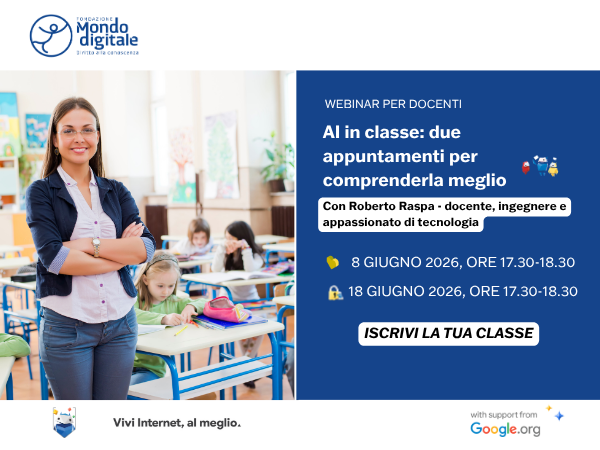
How can we guide students to use artificial intelligence critically, creatively and responsibly? As part of ‘Vivi Internet al meglio’, the training programme promoted by Fondazione Mondo Digitale ETS with the support of Google.org, we are offering two new webinars for teachers to bring simple, practical and immediately replicable activities into the classroom.
The sessions help explore key tools and concepts of AI literacy: from how generative artificial intelligence works to the role of data, from the importance of prompts to understanding errors, biases and the limitations of automated systems. The aim is to offer teachers practical resources to educate children and young people in the mindful use of technology, as part of a broader journey towards digital citizenship and online safety.
Each webinar lasts one hour and includes practical activities that teachers can adapt and use with their own classes. At the end of the session, participants receive a certificate of attendance, valid for the recognition of training hours completed, and supporting materials. Following the classroom trial, a micro-certificate for the teacher will be issued, recognising the skills acquired, along with a certificate of attendance for the students involved.
Target audience: primary, lower secondary and upper secondary school teachers.
8 June, 5.30–6.30 pm REGISTER FOR THE WEBINAR
AI in the classroom: from spectators to protagonists". Exploring NotebookLM, Gemini and TextFX for informed teaching
This webinar offers a practical immersion in three free Google tools – NotebookLM for querying and summarising documents, Gemini for conversing and creating with AI, and TextFX for playing with words creatively – linking them to key concepts of AI literacy: data as ingredients, pattern-based prediction, the importance of the prompt, and limitations related to bias and errors. The aim is to build the competence and confidence to guide students towards a critical, creative and responsible use of AI.
Objective: The webinar aims to develop teachers’ AI literacy skills and innovative teaching methodologies, fostering an informed understanding of how artificial intelligence works and its educational implications. Through guided use of NotebookLM, Gemini and TextFX, participants will acquire practical tools to design critical, creative and inclusive learning experiences.
Skills acquired:
- Understanding the principles of AI literacy and how generative AI works
- Using NotebookLM, Gemini and TextFX to design innovative teaching activities
- Developing prompting skills and the informed use of AI tools
- Promoting a critical, creative and ethical approach to artificial intelligence in the classroom
Trainer: Roberto Raspa, engineer, lecturer and expert in technology and educational innovation
18 June, 5.30–6.30 pm REGISTER FOR THE WEBINAR
AI in the Classroom: learn, create, think!
Using Google’s Teachable Machine, we will learn to build small AI models together with students, training the machine with images and sounds, observing its errors, and exposing its biases. The course translates the fundamental themes of AI literacy into concrete and engaging activities: how artificial intelligence works, why it can make mistakes or be unfair, and what it means to use it as informed digital citizens.
Ready-to-use activities that can be implemented immediately in the classroom in a cross-curricular and personalised manner according to the school year, with an additional resource at your fingertips to develop coding activities.
Objective: to introduce AI in a simple and playful way, highlighting the limitations and risks of machine learning.
Skills acquired:
- Designing hands-on activities to introduce artificial intelligence in the classroom
- Using Teachable Machine to create and test simple machine learning models
- Analysing AI errors, biases and decision-making processes whilst developing critical thinking
- Integrating AI literacy and coding into interdisciplinary and customisable teaching programmes
Trainer: Roberto Raspa, engineer, lecturer and expert in technology and educational innovation.