
Five in-depth articles dedicated to the 2025 Social Report. Here is the first
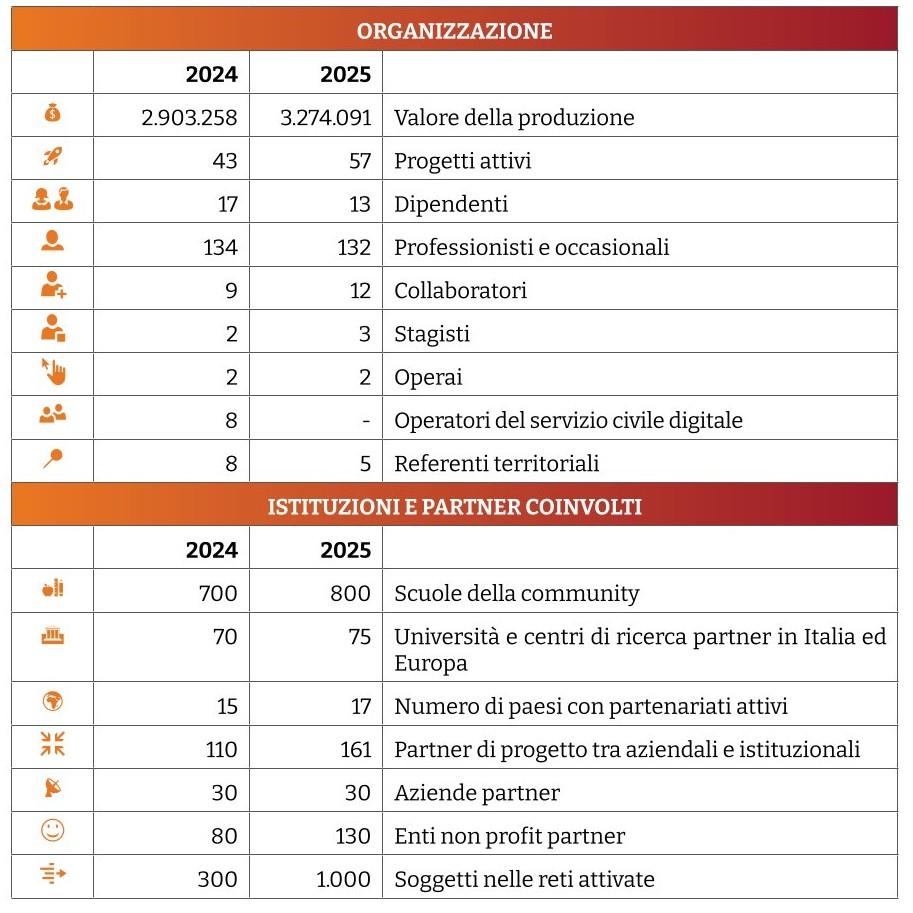
A social report is not just about tallying up what has been achieved. It can help us understand how an organisation is changing and, through its work, what transformations are taking place in schools, the workplace, local areas and communities. It is with this in mind that we present a series of in-depth articles based on the Fondazione Mondo Digitale’s 2025 Social Report. Not a string of figures, but five stories built around data that signal a shift: expanding networks, growing training programmes, professional skills becoming a shared asset, new ways of assessing impact, and forms of participation capable of reaching ever-wider audiences. In 2025, the Foundation carried out 57 projects, involved nearly 200,000 people, worked with 800 schools, 75 universities and research centres, and 161 partners, delivering 29,466 hours of training. But behind every figure lies, above all, a relationship: between people, organisations, knowledge and technologies. Having highlighted the people who make this work possible every day, we shall now continue our review of the Annual Report by examining some of the transformations that stand out most clearly.
From 300 to around 1,000 participants in local networks: growth does not simply mean carrying out more projects, but building connections that are built to last
There are organisations whose size is measured primarily by the number of people who work there. And others whose capacity for action is best understood by looking at the relationships they manage to build. For the Fondazione Mondo Digitale, 2025 seems to reflect this second type of growth above all. The number of active projects has risen from 43 to 57, but perhaps the most significant figure concerns the ecosystem that makes them possible. Project partners have grown from 110 to 161, schools in the community from 700 to 800, and partner universities and research centres from 70 to 75. And the number of organisations involved in the established networks has risen from around 300 to 1,000.
It is not merely a question of numbers. A network does not automatically become an ecosystem simply because the number of its nodes increases. It becomes an infrastructure when those connections begin to generate shared capacity: a school partners with a university, a business makes its expertise available, a local authority opens up a local area to experimentation, and a third-sector organisation reaches out to people and needs that would otherwise remain marginalised. This is perhaps one of the most interesting transformations emerging from the 2025 Social Report.
In the introduction to the document, Director-General Mirta Michilli describes the Foundation as a “social infrastructure for knowledge”, an ecosystem that connects people, institutions and technologies to generate educational opportunities and development across local areas. This definition also helps us to view the role of a third-sector organisation in a different light – not necessarily as an entity that directly provides all services, but as a platform capable of activating and combining resources already present in society. This approach is rooted in the Foundation’s very history. Its partnerships encompass schools, universities, businesses, foundations, associations, communities and public authorities; its international network now spans 40 countries, 20 of which are in Europe.
At a time when educational and social challenges are becoming increasingly complex, no organisation can tackle them alone. The quality of the response depends ever more on the ability to forge alliances between diverse areas of expertise.
This is why the increase from 300 to 1,000 partners in the local networks tells a story that goes beyond the Foundation’s growth. It shows that social innovation is taking the form less and less of an isolated project and more and more of a network that learns to function together.
Find out how the Fondazione Mondo Digitale transforms research, innovation and education into shared value for people and local communities.Browse the 2025 Social Report
There is still time to allocate your 5×1000 to the Fondazione Mondo Digitale ETS
Choosing our tax code means supporting projects that make the right to knowledge a real possibility for thousands of people across Italy.Find out how to contribute