
The DisclAImer tour concludes in Milan
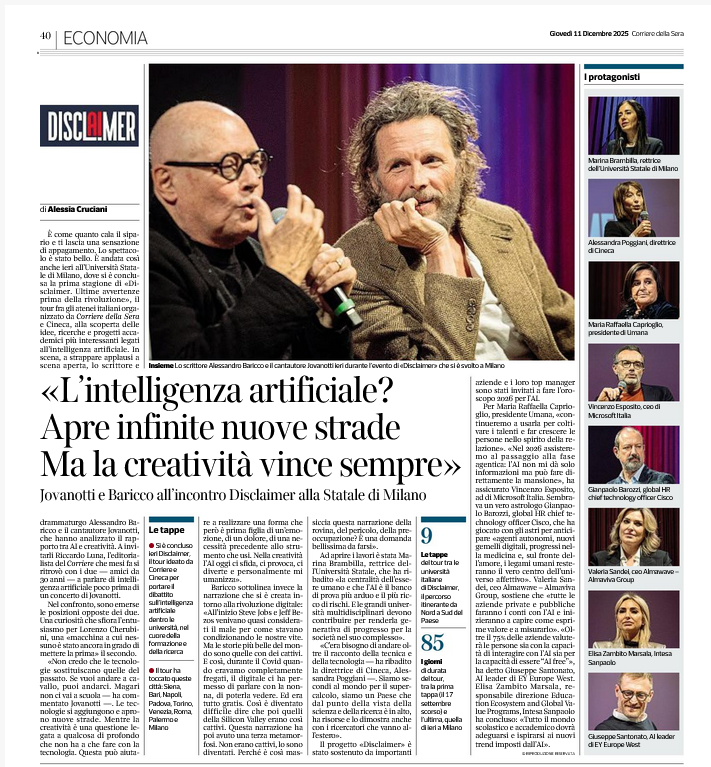
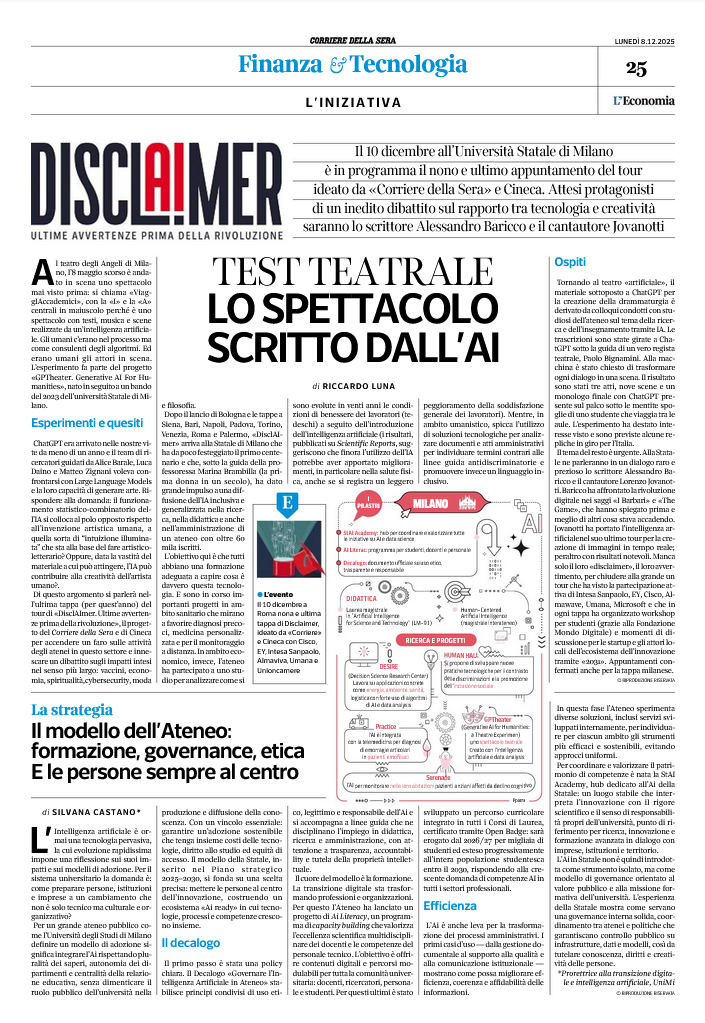
Yesterday, the DisclAImer. Last warnings before the revolution tour concluded with its final stop at the University of Milan. The nine-stop tour crossed languages, territories and communities, involving thousands of people and prominent figures such as Alessandro Baricco and Jovanotti, questioning our way of dealing with change.
This was the backdrop for the university challenge “Raccontare e raccontarsi con l'AI” (Telling stories and telling ourselves with AI), promoted together with the Fondazione Mondo Digitale, the tour's knowledge partner. This was not an isolated event, but the culmination of a shared journey, designed to help students develop a critical view of artificial intelligence and its impact on society.
A challenge as a training ground for critical thinking
The challenge was launched by Silvana Castano, Vice-Rector for Digital Transition and AI, and Alfio Ferrara, AI Literacy Delegate at the University of Milan. Twenty students, organised into four teams, worked on key contemporary issues:
- Algorithms and everyday life
- Health, biotechnology and the future of medicine
- Inequality and social justice in the digital age
- Environment, climate and collective choices
During the workshop, participants experimented with the use of generative AI as a tool to support analysis, writing and design. The aim was to create original stories on current issues, explore different narrative formats and use AI as a design lever, without sacrificing a critical view of the role of technology.
University and awareness: the words of the teachers
- Silvana Castano: "I am very happy with this challenge, which saw students from different faculties working together to construct stories on current issues, using artificial intelligence tools with a critical spirit and focusing on their creativity. The students' ideas remain the most important part: technology must serve to give shape to the content, messages and visions they want to share. I consider this an extremely formative experience and I thank Disclaimer and Fondazione Mondo Digitale for this opportunity offered to our students.‘
- Alfio Ferrara: ’We wanted to work on complex and current issues, such as the impact of technology on daily life, medicine, the environment and social inequalities. The aim was to help students use these technologies critically and responsibly, but above all to understand how they work. Content-generating systems are not neutral: only by understanding their mechanisms can they be used effectively. This awareness will be essential for anyone who encounters these tools in their professional and personal lives.”
The students' voices
- Cristian Castellano (team “Algorithms and everyday life”): “We reflected on how artificial intelligence can change everyday life, how much it can decide for us and how people can regain control of these tools, which are still somewhat mysterious today”.
- Silvia Guidi (team “Health, biotechnology and the future of medicine”): “We asked ourselves about the possible applications of AI in Italian public health. The potential is enormous: it is not just a question of solving existing problems, but of improving the experience across the board, both for patients and doctors. The opportunities concern not only diagnosis, but also research and development”.
- Simona Pitzalis (team “Social inequalities”): “We tried to understand the role of artificial intelligence in the context of inequalities, analysing the risks, critical issues and opportunities that this tool can offer”.
- Stefano Bruschi (team “Environment, climate and collective choices”): ‘It was a very stimulating workshop: working with students from other faculties allowed us to compare different points of view and build a richer presentation thanks to the plurality of skills.’
The Foundation's perspective: the value of “displacement”
Miriam Pintore, project officer at Fondazione Mondo Digitale: "This experience confirmed how multidisciplinary teams always have an edge. Bringing together different skills, perspectives and languages generated a rich and stimulating exchange. Seeing medical students working on inequalities or economists grappling with environmental challenges fostered a fundamental change in perspective. It is precisely in this “displacement” that the most authentic forms of innovation often arise and awareness grows of the role that each of us can play in shaping the future."
The ninth and final stop on the tour closed a journey, but opened up new questions: how we describe the present, how we imagine the future, what responsibilities we choose to take on, together.
Under the articles of the daily newspaper Corriere della Sera, promoter of the tour in collaboration with Cineca.