
What does working in social innovation actually mean today?
The third sector is growing and changing. According to INPS data cited by the newspaper Il Sole 24 Ore last Monday, in 2025 the number of workers in the non-profit sector reached 855,887, 25.3 per cent more than in 2019. And almost one in three employees is under 34 years of age [read the article Young People and the Third Sector: New Skills for Social Innovation].
Behind this growth in employment lies a transformation in professional roles. Social organisations are becoming increasingly complex and require skills capable of bringing together planning, management, technological innovation, communication, training, sustainability and impact assessment.
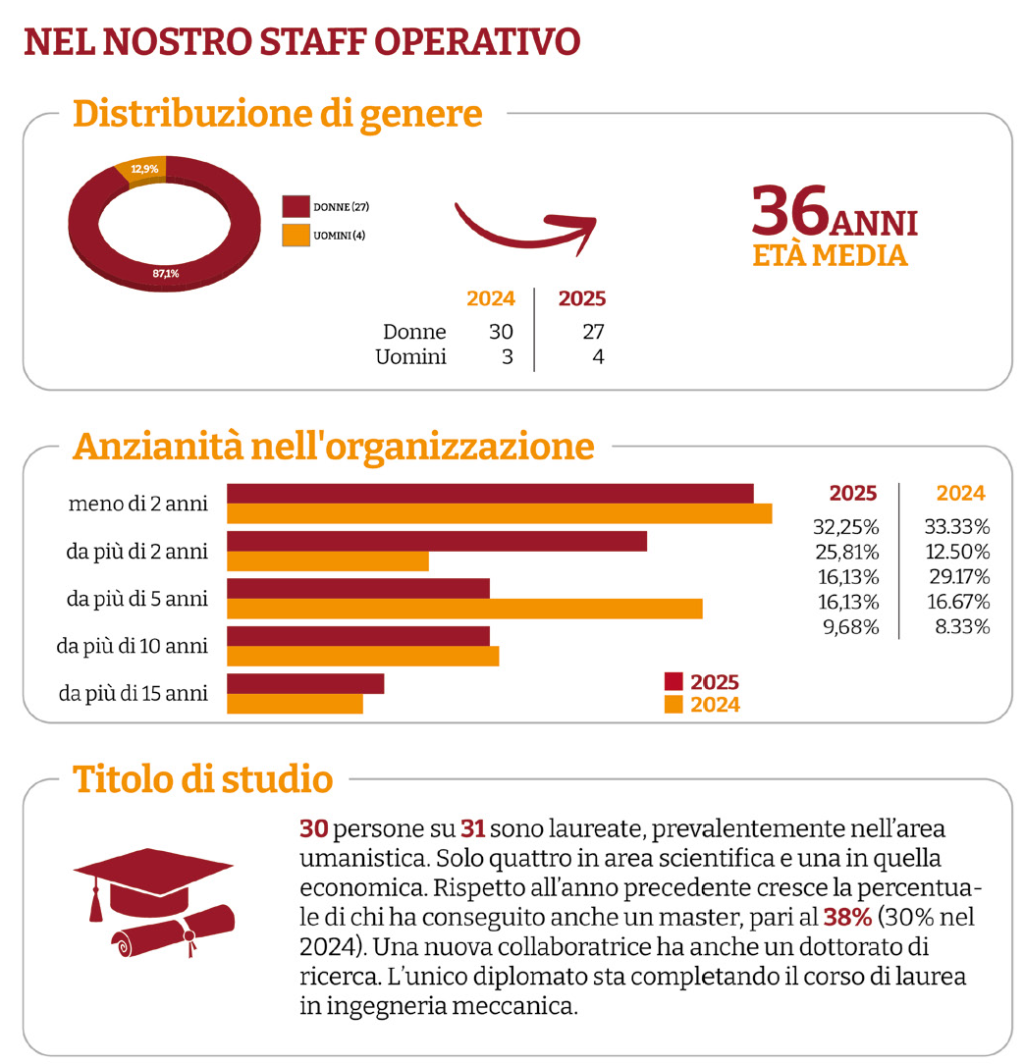
This trend is also evident in the 2025 Social Report by the Fondazione Mondo Digitale. The operational staff has an average age of 36 years and is predominantly made up of women: 27 out of 31 people. The data on education is particularly significant: 30 out of 31 people hold a degree, eight have completed a master’s degree, eleven have studied abroad and over a third have undertaken a PhD or research programme.
The composition of the team also reflects the evolution of professions within the field of social innovation. Skills range from design and research to project implementation, from communication and institutional relations to community development, right through to training and technological infrastructure. Alongside the staff, there is also a wider professional community: in 2025, 162 trainers were involved, in addition to collaborators, professionals, digital facilitators, apprentices and interns.
The Foundation also invests in the entry and development of the younger generation. In 2025, three extracurricular work placements were set up, with support from a company mentor; one of these placements subsequently led to an apprenticeship contract.
The challenge, however, is not limited to access to work. In organisations facing increasingly rapid technological and social change, it is essential to continue updating the skills of those already working within them. It is no coincidence that, in the Foundation’s 2026–2028 Strategic Plan, organisational strengthening and skills development represent one of the three pillars of future growth.
It is precisely in this regard that the FMD data align with the analysis put forward by Il Sole 24 Ore: the third sector is not merely a space where employment is growing, but a field in which new knowledge and new professional roles are emerging, called upon to transform innovation, knowledge and collaboration into value for communities.