
PariPasso, first webinar with Rizzoli Education on augmented teaching
"What would happen if we tried to read a text not only through the lens of the reader but also through that of an algorithm? This challenge transforms AI from a simple tool into a different “lens” through which to observe what happens between the pages. AI is not an oracle, but a probability calculation. A fundamental step in reassuring teachers about its ethical use is the distinction between “truth” and “probability”. Students are taught that AI output is not a truth, but a probability calculation. Understanding this limitation allows artificial intelligence to become not a “jack of all trades”, but a tool for critical analysis in the hands of students,“ explained Francesca Sabatini.
Felicia Bitetti likes to call herself a 'digital re-animator”, as her goal is to help even the most reluctant colleagues take advantage of technological opportunities to improve the quality of teaching. A significant part of her speech concerns the pedagogical value of digital challenges, where she explains that in Escape Rooms ‘mistakes... are not seen as something to be given a mark or a negative judgement, but there is always constructive feedback’, allowing students to learn from their mistakes in a cooperative environment.
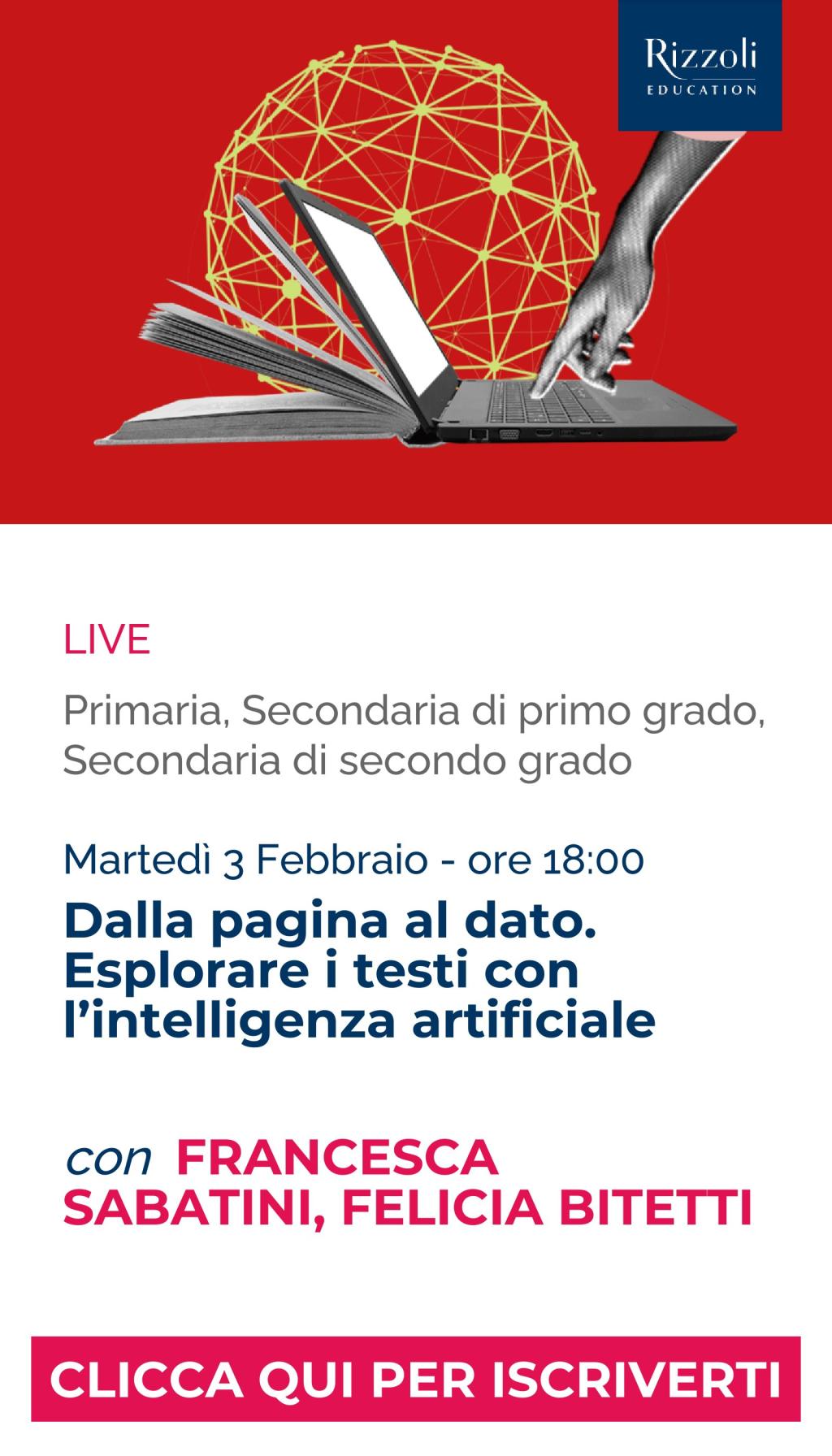
Last Tuesday saw the official launch of the collaboration between Fondazione Mondo Digitale ETS and Rizzoli Education with the webinar From page to data. Exploring texts with artificial intelligence, the first event in the training course on augmented teaching, designed to accompany teachers in the critical and conscious use of AI in educational planning. The webinar is part of PariPasso, a project dedicated to inclusion in schools and the sharing of fair, accessible and high-quality teaching practices.
AI as an ally of deep reading
During the meeting, trainers Francesca Sabbatini and Felicia Bitetti showed how generative artificial intelligence can become an ally of deep reading, rather than a shortcut.
An emblematic case study concerned I Promessi Sposi: through sentiment analysis, students can map the “tangle of emotions” of the Unnamed, comparing human interpretation with computational calculation. This exercise stimulates empathy, critical thinking and metacognitive reflection, helping to overcome the idea of AI as an “oracle” and to understand its probabilistic and interpretative nature.
Digital escape rooms and cooperative learning
In the second part of the webinar, the focus shifted to the design of digital escape rooms as tools for strengthening motivation, cooperation and problem solving in the classroom.
Using platforms such as Genially and LearningApps, teachers explored the construction of data-based puzzles and missions, according to a key principle of the course: “Made with AI, not by AI”, to enhance technology as an extension of human capabilities and not as a substitute for thinking.
Available materials and upcoming events
Due to bad weather, there were some technical connection problems. We apologise for the inconvenience and thank the participants for their understanding, inviting them to review the recording and available materials.
To enable teachers to replicate the activities in the classroom, the FMD Academy provides operational materials and customisable teaching sheets for primary and secondary schools: video tutorials, a mini guide to AI and the prompts used during the training sessions.
Upcoming events in the first cycle of webinars
“Augmented teaching. From words to data, from data to knowledge”

Thursday 12 February, 6.30 p.m. (1 hour)
The Inquiry Method. Designing a research path with AI
Curated by Fondazione Mondo Digitale
With Annamaria Bove Iscriviti
Tuesday, 17 March 2026, 6:30 p.m.
Designing with AI. Strategies and tools for personalised learning
With Gaetano Manzulli and Daniela Pieraccini Iscriviti
A shared path towards a higher quality and more equitable school system
PariPasso stems from Rizzoli Education's commitment to promoting a culture of inclusion that combines educational effectiveness with attention to individual needs. The project, with a solid scientific structure and a committee of experts, offers editorial content, services and continuing education opportunities to support the daily work of schools.
The webinars are one of the first steps in this “step-by-step” journey, offering educational communities practical tools to tackle the challenges of technological innovation with responsibility, critical thinking and an inclusive vision.