
Report on the final event of the Roma Rigenera Impresa project
Yesterday morning, the Casa delle Tecnologie Emergenti in Rome hosted the final event of the Roma Rigenera Impresa project, an initiative promoted by the Department of Productive Activities, Equal Opportunities and Investment Attraction of Roma Capitale in the neighbourhoods of Tor Bella Monaca, Corviale and Santa Maria della Pietà. The project, part of the Integrated Urban Programmes (PUI) and supported by the National Recovery and Resilience Plan (PNRR), saw the active participation of emerging businesses, third sector organisations, schools and local institutions and is the result of co-design by Ashoka Italia, Uno Aps and Fondazione Mondo Digitale. The event was a unique opportunity to gather testimonials from the protagonists, but also the reflections of public administrators on the concrete impact of the project and the importance of regeneration not only of places but also of communities [see the news item Final event of Roma Rigenera Impresa].
The morning was opened by Monica Lucarelli, Councillor for Productive Activities of the Municipality of Rome: ‘In four years, we have accompanied many young people in setting up businesses with the Centre for Emerging Technologies, an interesting way to open up the administration to the private sector and make it known to young people who feel it is distant from them’. She then highlighted the value of the actions that public actors have undertaken towards the more peripheral neighbourhoods: "We have adopted the Integrated Urban Plans (PUI) with the result of significant redevelopment actions in the territory of Rome, because we feel the duty to bring opportunities to the neighbourhoods, both in terms of interventions on physical spaces and in terms of services offered. In the coming months, places similar to the CTE will be inaugurated in the three neighbourhoods to offer opportunities and growth. Businesses are born not so much thanks to brilliant ideas or improvised garages, but rather thanks to skills. This is precisely where we started with the Roma Rigenera Impresa programme."
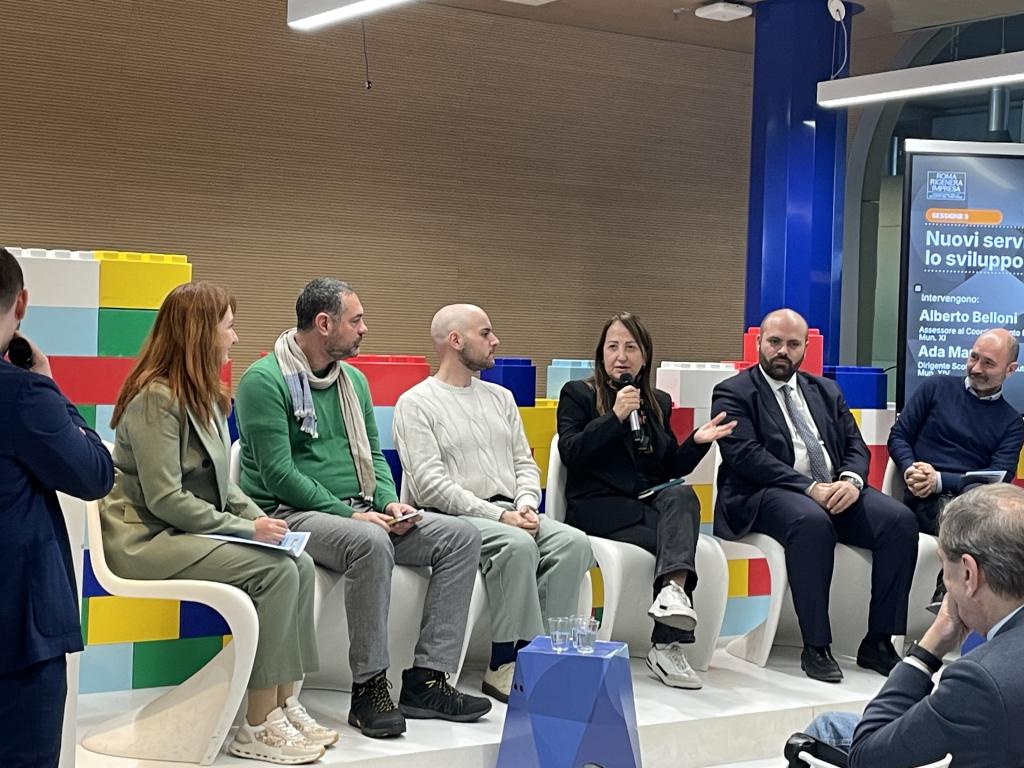
During the first session, moderated by Federico Mento, director of Ashoka Italia, the discussion focused on new digital services for inclusion and urban development. Mento emphasised the importance of the relationships built during the project: ‘I hope that the human relationships forged during this journey can continue. We have shown that in Rome we can achieve social innovation thanks to a real partnership between civil society and public administration. A strong connection is being created between those who own the technologies and those who are responsible for promoting social innovation.’
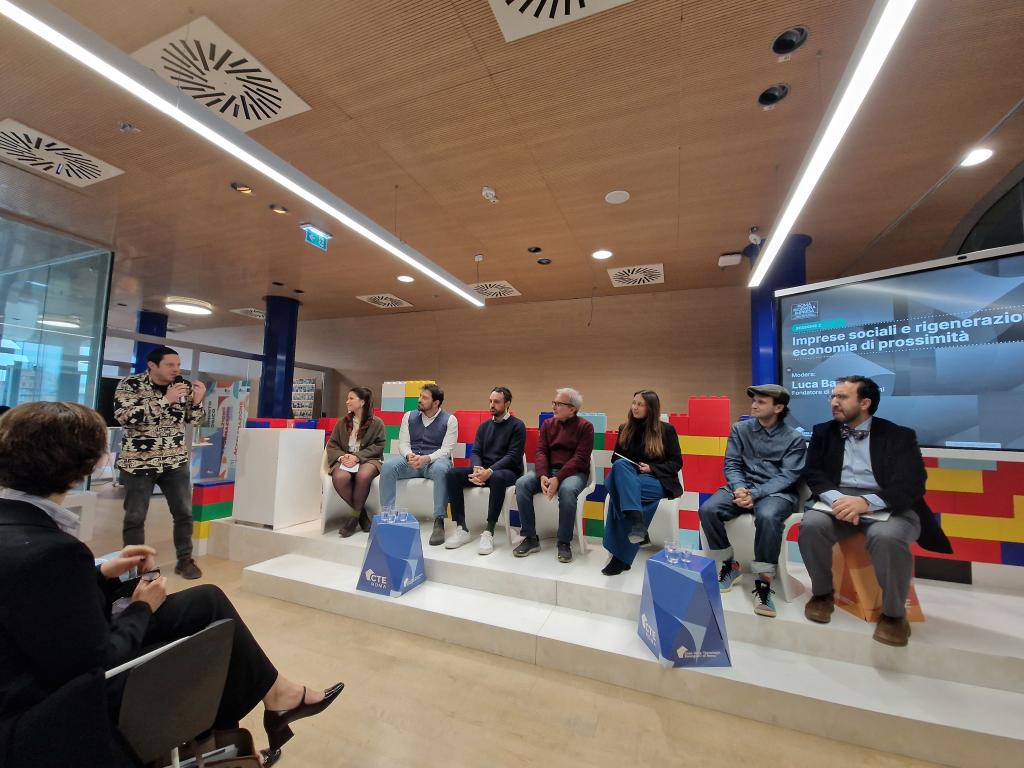
Luca Bazzoli of Uno Aps facilitated the session dedicated to local economy models, highlighting the value of collective work: ‘We try to create unified paths for the common interest and, in this case, we have encouraged intense moments of sharing in the territories.’
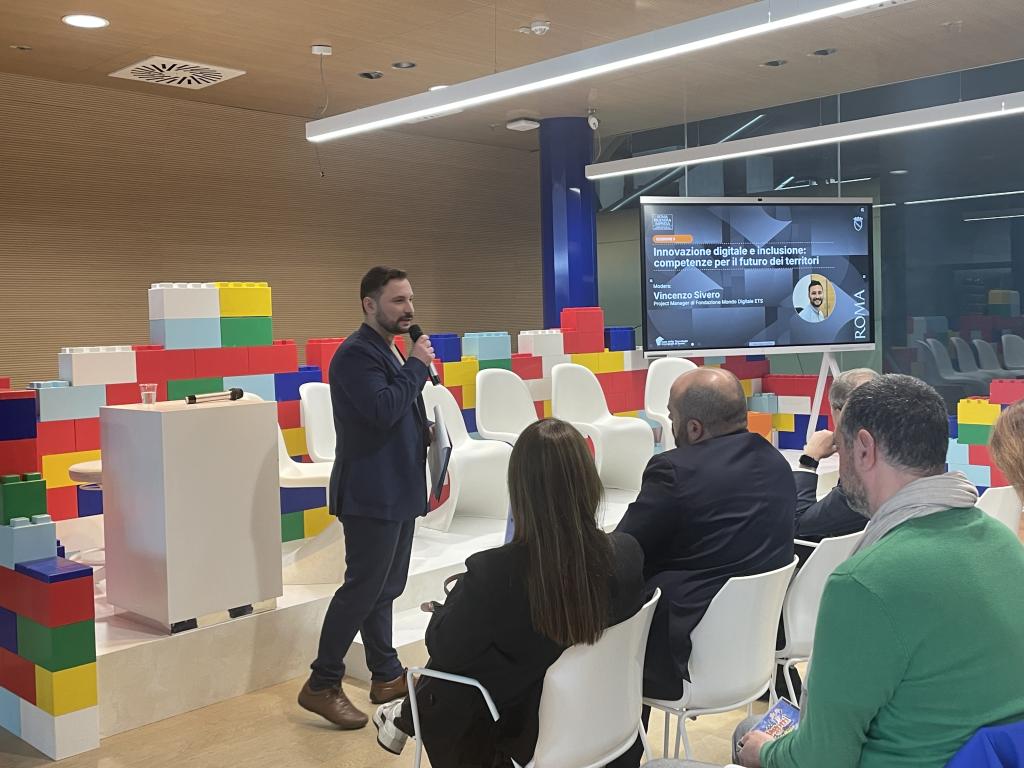
In the panel dedicated to digital skills, Vincenzo Sivero, project manager of the Fondazione Mondo Digitale, began: "For us, technology must be an enabling factor for everyone, and when we were called upon to contribute, we accepted in order to make these spaces of innovation suitable for the citizens of the territories involved. In our panel, we want to give the floor to the participants in the courses organised to show the real impact on people." The Foundation offered technical and professional training with micro-certification, simulated business activities, a start-up course (business model and digital marketing, digital awareness activities) and activities aimed at schools. During the session, three participants in the Python and Digital Marketing courses shared their stories: Maryna Fraint (Python and Digital Marketing courses at IC Fratelli Cervi), Cristian Salvatore Miglietta (basic and advanced Python course at IC Melissa Bassi), and Fabio Canestrari (Python course in Municipio XIV).
Ada Maurizio, head teacher at the Domizia Lucilla Institute (Municipality XIV), which hosted the course with sessions dedicated to student guidance, recalled:
‘We are a unique school, we also collaborate with the Casal Del Marmo Juvenile Detention Centre, which is why today I appeal to those present not to forget the teenagers in our large suburbs, who are going through a very sensitive and problematic time.’
Alberto Belloni, Councillor for the coordination of PNRR interventions in Municipio XI, added: ‘It is essential that interventions in the physical environment go hand in hand with those relating to citizenship, in order to reduce the social vulnerability index of many areas, contaminating spaces and supporting people. We are working to create places of revitalisation that are inhabited by socially active entities.’
Francesco Montillo, professor of civil engineering at Sapienza University of Rome, framed urban regeneration as a lever for equity: “We need to combat the social marginalisation of those areas that have historically gathered a fragile population, which has not been offered real opportunities. We must support the ideas that arise and make them achievable”.
The event was concluded by Giuseppe Battaglia, Councillor for the Suburbs of Rome Capital, who highlighted the uniqueness of the project: "We are one of the few cases in Italy to have managed PNRR funds for intangible activities, financing cultural spaces such as cinema arenas and articulating digital innovation interventions. This is a significant operation because it promotes the suburbs not as places far from the centre, but as places that receive little attention."
 The story is by Onelia Onorati, press office of the Fondazione Mondo Digitale.