

PariPasso: second workshop webinar with Ilaria La Manna
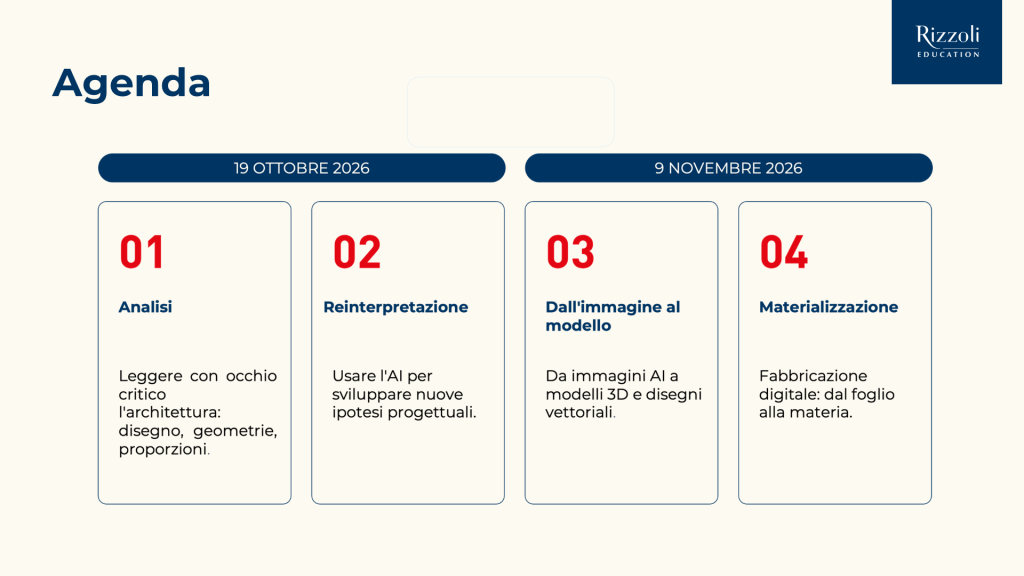
Having imagined new architectural designs, the time has come to try and build them. In the second session of Beyond the Frame. AI, Drawing and Architecture Workshop, held yesterday, 9 November, Ilaria La Manna guided teachers through a step-by-step process, starting with the reinterpretations developed in the first webinar and progressing to the three-dimensional model and preparation for 3D printing. The workshop forms part of PariPasso, the Rizzoli Education project dedicated to educational inclusion, and completes the programme that began on 19 October with the analysis and reinterpretation of three very different architectural works: the Pantheon, the Palazzo della Civiltà Italiana and the MAXXI. In the first session, the work did not begin with a prompt, but with observation, drawing and an understanding of the building. In the second session, the process continues in the opposite direction: from the digital image towards the physical object. “We’ll take it step by step,” explained Ilaria La Manna at the start of the workshop, “to transform this image into a three-dimensional model” and then understand how to bring it to life.
Preparing the image
Even before creating the 3D model, we need to edit the image generated in the previous workshop. People, decorative elements or unnecessary details can, in fact, confuse the systems tasked with reconstructing the three-dimensional geometry. In the example used during the live stream, La Manna removed the figures from the image to leave only the architectural structure. It is a seemingly technical step that illustrates an important educational principle: an AI-generated result must be examined, selected and prepared according to the next objective.
One image, three different models
The focus of the workshop was a comparison of three tools capable of transforming two-dimensional images into three-dimensional models: Meshy, Tripo and 3D Valley. The same reinterpretation of the Pantheon was uploaded to the different platforms to compare their rendering, materials, editing capabilities and limitations. And it is precisely here that one of the most interesting aspects of the experience emerges. In the transition from image to 3D model, the system can introduce elements that did not exist in the initial design, modify others or interpret certain shapes differently. In one of the experiments, for example, the model transformed some arches into doors and added a column that was absent from the original image. “You can see that the AI has generated its own interpretation,” observes La Manna. For students, this means learning to compare the result with the design intention, identify inconsistencies and decide what to retain, correct or regenerate.
When the error becomes part of the design
Downloading a model in STL format does not mean it is ready to be printed. During the webinar, the file imported into the printing software contained several elements detached from the structure. The system flagged these as errors, and the model underwent a further process of checking and repair. Only after the corrections had been made was it possible to re-import it, resize it according to the print plan, add the necessary supports and prepare the print plate. The transition from image to object therefore requires one to grapple with real-world constraints: scale, structure, stability, materials, dimensions, supports. It is here that the workshop takes on particular educational value. An image may appear perfectly plausible on screen yet prove problematic when it has to become a physical object. Students are required to revisit the project, review their choices and amend them. The process thus becomes a design exercise: conceiving, representing, verifying, correcting and realising.
From 3D to laser cutting and vinyl
3D printing is just one of the possible outcomes. La Manna also demonstrated how an image can be simplified and transformed into a two-dimensional composition, suitable for vinyl cutting, or converted into a vector drawing and broken down into elements intended for laser cutting. The same architectural concept can therefore be interpreted through different materials and techniques, working with solids and voids, layers, colours and composition. For the class, this means linking together skills that are often tackled separately: art history, drawing, geometry, design, modelling, artificial intelligence and digital fabrication.
From paper to matter
In her concluding remarks, Ilaria La Manna summarised the entire course with a very effective phrase: “from paper to matter”. The initial sketch can pass through artificial intelligence and digital fabrication tools until it is transformed into a new physical representation of the architectural concept. And this is probably the most interesting aspect of the Beyond the Frame programme: AI does not conclude the creative process with an image. That image, in turn, becomes material to be examined, controlled and transformed. Anyone who was unable to attend the live session can watch the full recording of the webinar and follow, step by step, the experiments proposed by Ilaria La Manna, from the 3D model to preparing the file for printing.
Watch the recording of “Beyond the Frame. AI, Drawing and Architecture Workshop”
The Fondazione Mondo Digitale is also providing participating teachers with a practical guide containing all the steps and links used in the two sessions, so that the activities can be replicated in the classroom.


