
We are in the midst of the III National Week of STEM Disciplines (4–11 February) and training continues for the Coding Girls & Women project, supported by the Ministry of Labour and Social Policies (Notice 2/2024). In Rome, on Wednesday 4 and Friday 6 February, trainers Marco Brocchieri (IC Raffaello) and Jamila Naffati (IC A. Manzi) used the Scratch language to guide pupils through creative storytelling, inspiring reflections on gender inequalities in the digital world.
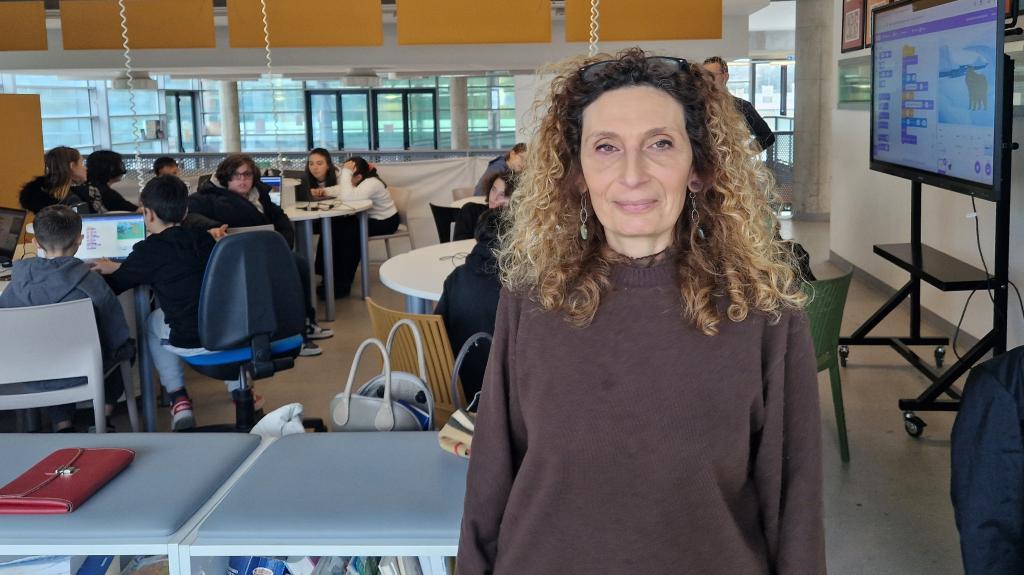
The Raffaello comprehensive school is located in the Romanina area and is known nationally for its light and bright architecture. The school, designed by the ATP Herman Hertzberger studio and Marco Scarpinato, was a finalist for the “Quality Architecture for Quality Schools” award in 2014. It welcomes its students into modular, shared spaces, full of light and natural materials in light colours. There are no buildings next to it, only small, family-friendly residential complexes. In short, it does not feel like one of the most populous neighbourhoods in the capital, Tuscolano.
Here, last Friday, Marco Brocchieri guided two secondary school classes (first and third year) in discovering block programming. Some began to create fantastic stories populated by elves, fairies and goblins. Others drew on more realistic scenarios, such as a pink “food truck” selling ice cream and pastries, run exclusively by women.
The meeting with the Fondazione Mondo Digitale came about thanks to Italian teacher Tiziana Bifolco, who has known us for some time and shared many educational adventures with us when she was a teacher at the IC Gigi Proietti school. “Today, there is a shared desire to promote STEM subjects in Italian schools. Furthermore, as a literature teacher, I feel compelled to broaden the horizons of teaching and give young people useful tools for their education,” the teacher told us.
‘I cherish the work I did with the Fondazione Mondo Digitale on projects such as Nonni su Internet (Grandparents on the Internet) a few years ago, and I find this training proposal to be of great value! My colleague Barbara Perrini, who teaches mathematics, was also already familiar with the Palestra dell'Innovazione in Via del Quadraro, and we thought it would be important to replicate past positive experiences.’
Prof. Bifolco is well aware of the cross-cutting nature of computational thinking, "because it teaches you to think in terms of processes. Young people today are used to receiving poorly organised information, and it is important that they are able to select the important information, put it in order and understand its consequences. Coding develops this skill, the ability to organise and review, i.e. to evaluate mistakes as learning opportunities. This type of analysis can be transferred to other areas, such as history, through cause and effect relationships, summarising texts... it is an attitude for life which, if nurtured, can be applied in many different situations."
In lower secondary school, there is still a gender gap in educational orientation. "However, unlike in the past, girls today choose languages rather than classical and humanistic studies, while boys favour IT. So it is really important to offer opportunities like today's starting in primary school to rebalance this situation! We need to encourage coding activities by offering experiences such as Scratch and early computer programming," concluded the teacher.
 The story is by Onelia Onorati, press office of the Fondazione Mondo Digitale.